

Die Cannabispflanze ist organisierter und strategischer, als sie aussieht. Nur die weibliche Pflanze produziert die harzigen Blüten, wo fast die gesamte Pflanze psychoaktive und therapeutische Verbindungen, THC, CBD und ihre Begleitstoffe Cannabinoide und Terpene sind konzentriert. Fast die gesamte aktive Chemie wird in mikroskopisch kleinen Drüsen hergestellt, die als Trichome die auf der Oberfläche spezifischer Gewebesätze sitzen. Das Verständnis der Pflanzenanatomie vom Wurzelhaar bis zum Trichom ist die Grundlage, auf der jeder ernsthafte Anbauer, Extraktor und Qualitätsspezialist in der europäischen Industrie seine Arbeit aufbaut.
Betrachtet man eine reife Cannabispflanze, sieht man leicht ein unscharfes grünes Durcheinander aus Blättern, Blüten und Haaren. Schaut man genauer hin, tut die Pflanze etwas erstaunlich Präzises. Sie wächst in ordentlichen Knoten. Sie schickt ihre wertvollsten Produkte an eine Handvoll spezifischer Strukturen. Sie trennt Männchen von Weibchen. Und sie produziert fast alles Cannabinoide und Terpene in winzigen pilzförmigen Fabriken auf der Oberfläche ihrer Knospen. Sobald Sie diese Teile benennen können, hört alles von einer Anbau-SOP bis zu einem Analysezertifikat auf, wie Fachjargon auszusehen.
Dies ist der zweite Artikel unserer Cannabis 101-Reihe, ein Leitfaden in einfacher Sprache für Fachleute, die in den europäischen Sektor einsteigen. Im ersten Artikel behandelten wir die 10.000-jährige Geschichte von Cannabis, von der antiken Medizin über das moderne Verbot bis hin zur aktuellen europäischen Wiederbelebung; hier betrachten wir die Pflanze selbst. Ob Sie einen portugiesischen Züchter überprüfen, in Berlin ein Rezept ausstellen oder einen neuen bewerten Kultivar Für eine Klinik in Großbritannien ist die Anatomie der Ausgangspunkt für die Konversation. Wir streben keinen Botanikabschluss an, sondern das mentale Modell, das Sie tatsächlich benötigen, um den Markt zu verstehen.
Die allgemeine Anatomie: Gemeinsam für jede Cannabispflanze
Bevor wir uns damit befassen, was eine weibliche Cannabispflanze medizinisch wertvoll macht, ist es hilfreich, die Teile zu kennen, die jede Cannabispflanze, ob männlich oder weiblich, gemeinsam hat. Dies sind die strukturellen, vegetativen Komponenten: das Skelett, auf dem später die interessantere reproduktive Chemie der Pflanze aufgebaut wird.
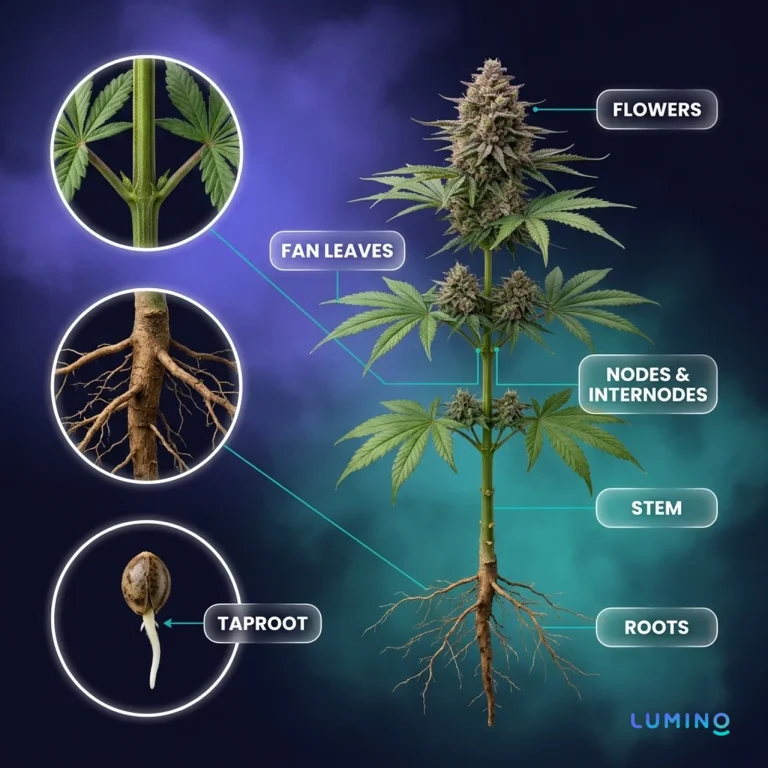
🟣 Wurzeln. Wenn ein Cannabissamen keimt, taucht zuerst eine einzelne Hauptwurzel auf, die sogenannte Taproot, welche gerade nach unten wächst und die Pflanze verankert. Wenn die Pflanze reift, bilden sich sekundäre und tertiäre Seitenwurzeln Verzweigen sich von der Pfahlwurzel ab und bilden ein breiteres, faseriges Netzwerk, das den Großteil der Wasser- und Nährstoffaufnahme übernimmt. Die Pfahlwurzel selbst verschwindet nicht; sie bleibt das zentrale Verankerungsorgan der Pflanze für ihr ganzes Leben. (Erwähnenswert: Cannabis, das aus einer) Klon, was bedeutet, dass sie aus einem Steckling und nicht aus einem Samen gewonnen wird, besitzt keinen direkten Wurzelballen, sondern nur faserige Adventivwurzeln, was einer der Gründe ist, warum Klone sich im Boden unterschiedlich verhalten. Wurzeln beherbergen auch nützliche Mikroben, die Vitalität und Terpenausprägung beeinflussen, weshalb moderne Züchter Substrat, Sauerstoffzufuhr und Bewässerungstaktik große Aufmerksamkeit schenken.
🟣 Stamm. Der zentrale Stiel transportiert Wasser und Zucker zwischen Wurzeln und Blättern und verleiht der Pflanze die mechanische Festigkeit, um ihre Blüten zu tragen. Im reifen Zustand hohl und durchgehend faserig, ist er dasselbe Gewebe, aus dem seit Tausenden von Jahren Hanfseile und Textilien hergestellt werden.
🟣 Knoten und Internodien. A Knoten die Stelle am Stängel, an der Äste und Blätter austreten; der Abstand zwischen den Knoten ist der Internodium. Der Abstand der Knoten ist ein nützlicher Indikator für den Wachstumsstil. Eng beieinander liegende Knoten bedeuten normalerweise eine kürzere, dichtere Pflanze; lange Internodien deuten auf eine größere, stärker gestreckte Pflanze hin. Dies ist oft das Erste, was einem erfahrenen Züchter auffällt, wenn er einen Blüteraum betritt.
🟣 Fächerblätter. Die großen, ikonischen siebenblättrigen Blätter sind die Solarzellen der Pflanze. Sie enthalten fast keine Cannabinoide und werden normalerweise bei der Ernte abgeschnitten, aber sie sind der Motor der Photosynthese und der erste Ort, an dem sich Stress zeigt (Gelbfärbung, Kräuselung, Fleckenbildung). Aus diesem Grund sind die Fächerblätter eines der Hauptmerkmale, die ein Züchter täglich beobachtet. Sie sind im Grunde das Armaturenbrett der Pflanze, und jede Veränderung der Farbe, Haltung oder Textur ist ein frühes Signal dafür, dass etwas in der Umgebung (Licht, Nährstoffe, Wasser, Schädlinge oder Krankheiten) Aufmerksamkeit erfordert.
🟣 Blumen. Beim Reifegrad entwickelt die Pflanze Blumen an den Spitzen seiner Zweige. Jede Cannabispflanze produziert Blüten, aber wie diese Blüten aussehen und was sie enthalten, hängt ganz davon ab, ob die Pflanze männlich oder weiblich ist. Diese Unterscheidung ist der Punkt, an dem Cannabis aufhört, wie ein gewöhnliches Kraut auszusehen, und anfängt, wie eine medizinische Pflanze auszusehen, und darum geht es im nächsten Abschnitt.
🌱 Fun Fact:
Das ikonische siebenblättrige Cannabissamenblatt ist ein Marketingbild, keine botanische Regel. Cannabisfolletten können reichen von 3 bis 13 Finger Abhängig von Genetik, Pflanzenalter und Position an der Pflanze haben die allerersten “echten Blätter”, die ein Sämling produziert, fast immer nur eine einzige Blattspreite.
Männlich vs. weiblich: Warum das Geschlecht wichtig ist
Cannabis ist eine von einer kleinen Gruppe von Pflanzen, die natürlicherweise zweihäusig, bedeutet, dass einzelne Pflanzen entweder männlich oder weiblich sind und nicht beide Fortpflanzungssysteme an derselben Pflanze tragen. Diese einfache biologische Eigenart erweist sich als eine der kommerziell wichtigsten Tatsachen in der gesamten Branche.
🟣 Männliche Pflanzen produzieren kleine, Pollen gefüllte Säcke an den Knoten, ungefähr in der Form und Größe eines Reiskorns. Wenn diese Säcke reifen, spalten sie sich und setzen Pollen in die Luft frei. Männliche Blüten enthalten sehr geringe Mengen an Cannabinoiden und werden nicht zur Herstellung von Medikamenten verwendet. Ihre Aufgabe im kommerziellen Umfeld ist rein genetischer Natur: sie sollen weibliche Tiere in einem kontrollierten Zuchtprogramm befruchten oder entfernt werden, bevor sie dies tun können.
🟣 Weibliche Pflanzen kann die dichten, harzigen Blüten hervorbringen, die wir normalerweise als [...] bezeichnen Knospen. Dies sind die Blüten, in denen fast alle Cannabinoide und Terpene der Pflanze konzentriert sind und aus denen medizinische Extrakte, getrocknete Blütenrezepte und fertige Cannabisprodukte hergestellt werden. In einer kommerziellen Anbauumgebung ist die gesamte Ernte weiblich.
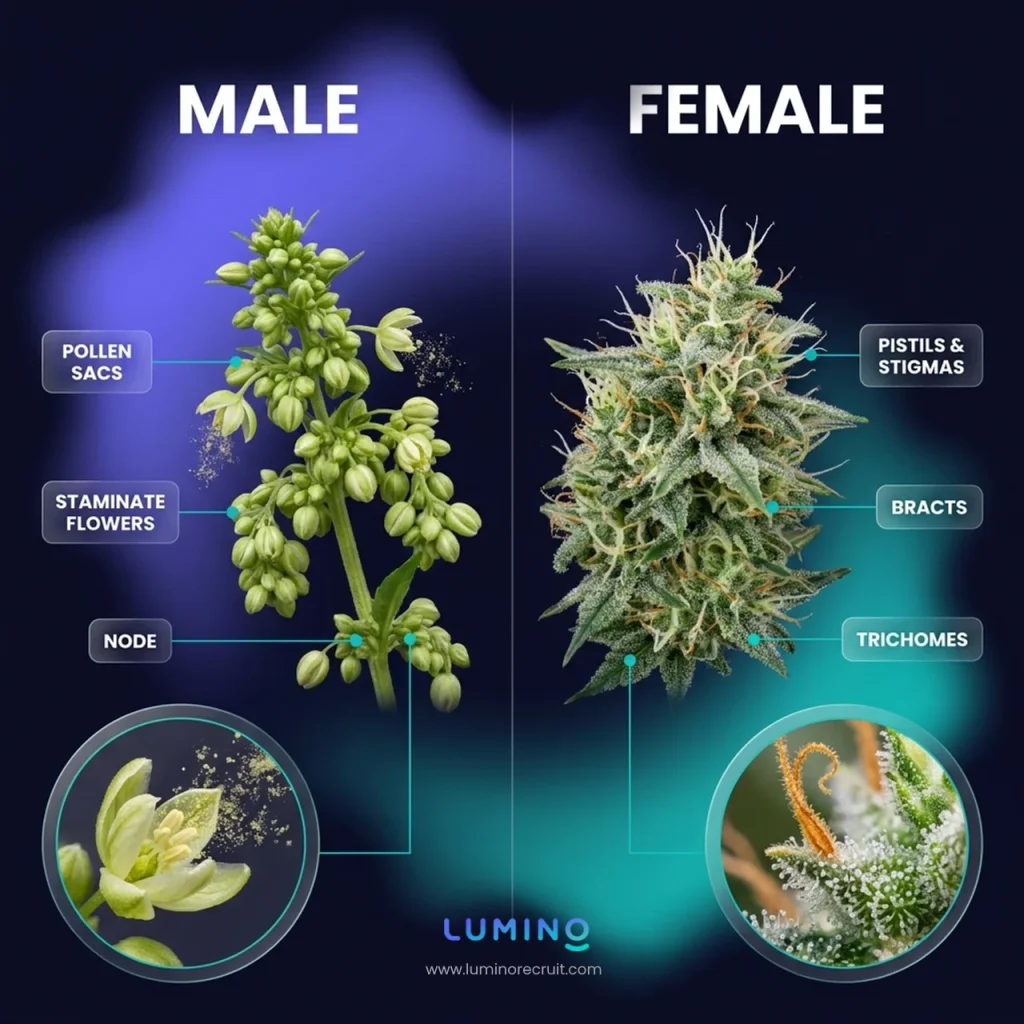
Wenn eine männliche Pflanze in einem Raum voller weiblicher Pflanzen belassen wird, bestäubt sie diese. Sobald eine weibliche Pflanze bestäubt ist, hört sie auf, ihre Energie in die Harzproduktion zu lenken, und beginnt stattdessen, Samen zu produzieren. Bestäubte Blüte ist dramatisch weniger potent, weniger aromatisch und weniger wertvoll als Blüten ohne Samen. Das ist der Grund, warum professionelle medizinische Züchter erhebliche Anstrengungen unternehmen, indem sie aus feminisierten Samen oder Stecklingen anbauen, jede Pflanze frühzeitig nach Geschlechtern trennen und alle Männchen sofort entfernen, um ihre Räume vollständig männchenfrei zu halten.
Ein verwandter Begriff, den Sie auf jeder Anbaustation hören werden: Sinsemilla, aus dem Spanischen kernlos bedeutet “ohne Samen” und ist die Bezeichnung für die hochpotente, unbefruchtete weibliche Blüte, auf denen der medizinische und Premium-Markt aufgebaut ist. Jedes Gramm medizinisches Cannabis, das heute in Europa abgegeben wird, ist im Wesentlichen Sinsemilla.
Es gibt eine weitere Komplikation, die es wert ist, zu wissen. Unter Umweltstress (Hitze, Lichtunterbrechung, physische Schäden) kann eine weibliche Pflanze gelegentlich eine kleine Anzahl von männlichen Blüten an ihrem eigenen Gewebe produzieren. Dies wird als Hermaphroditismus, und es kann einen Raum von innen heraus bestäuben. Die Verhinderung ist einer der Gründe, warum eine gut geführte medizinische Anbauumgebung so obsessiv auf Konsistenz bei Temperatur, Luftfeuchtigkeit und Lichtzyklus achtet.
🌱 Fun Fact:
Das Wort “Sinsemilla” betrat in den 1970er Jahren durch kalifornische Züchter, die Genetik und Techniken aus Mexiko importierten, die englische Sprache. Heute wird es in europäischen Dokumenten für den medizinischen Anbau sachlich verwendet und trägt leise seine spanische Grammatik in pharmazeutisch anerkannte Unterlagen ein.
Die weibliche Blüte im Nahaufnahme
Nachdem wir nun wissen, warum uns die weibliche Pflanze interessiert, lohnt es sich, einen Blick darauf zu werfen, woraus ihre Blüten tatsächlich bestehen. Hier finden Sie die meisten Vokabeln, die Sie auf Laborberichten, Anbau-SOPs und Produktverpackungen sehen werden.
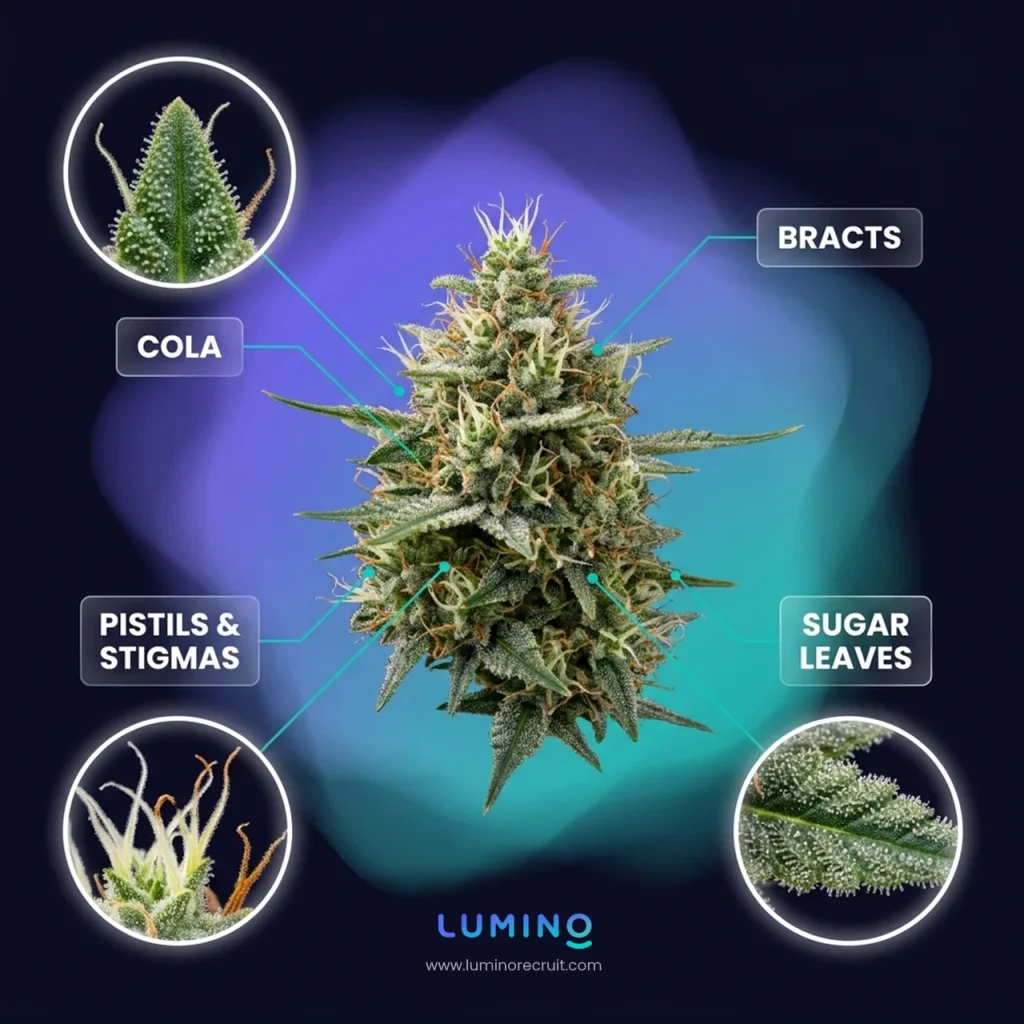
🟣 Cola. Die Cola (vom Spanischen für “Schwanz”) ist das Blütenstand. Die größte, dichteste Cola sitzt ganz oben an der Pflanze und wird oft als bezeichnet apikale Cola oder Hauptblütenstände; kleinere, sekundäre Blütenstände wachsen entlang der Spitzen von Seitenästen. Blütenstände entwickeln sich dort, wo die Pflanze das meiste Licht erhält, und sie enthalten die höchsten Konzentrationen an Cannabinoiden und Harz.
🟣 Hochblätter (oft als Kelchblätter bezeichnet). Zoomen Sie in eine Cola hinein und sehen Sie tatsächlich einen Stapel kleiner, tränenförmiger Strukturen, die als Hochblätter. Jede Spreublatt ist eine blattähnliche Hülle, die das Samenanlage der Pflanze (der potenzielle Samenort) umgibt und schützt. Spreublätter sind, technisch gesehen, das Cannabinoid-reichste Gewebe der gesamten Pflanze, da sie absolut mit Trichomen bedeckt sind. Die meisten Leute in der Branche nennen sie beiläufig Kelche, die ist botanisch inkorrekt, aber universell verstanden, daher tauchen beide Begriffe in der Branchenliteratur auf.
🌱 Fun Fact:
Was in der Branche jeder als ein “Kelch” ist technisch gesehen das falsche Wort. In der echten Botanik ist ein Kelch (Calyx) der kleine grüne Tasse am Fuß einer Blume (Denk an den blattartigen Teil, der eine Rose stützt). Cannabisblüten haben eigentlich keinen. Das tropfenförmige Stück, auf das wir zeigen, ist eigentlich ein Hochblatt, ein modifiziertes Blatt, das die Samenanlage umhüllt. Die Verwechslung blieb bestehen, einfach weil frühe Züchter das nächstklingende Wort verwendeten, das sie kannten, und als Botaniker sie korrigierten, war es bereits in jedem Zuchtleitfaden und auf jedem Produktetikett.
🟣 Stempel und Narben. Aus jedem Hochblatt ragen zwei dünne, haarähnliche Strukturen heraus. Diese sind die Stigmata, und bilden zusammen mit der darunter liegenden Samenanlage das weibliche Fortpflanzungsorgan der Pflanze, den Stempel. Ihre evolutionäre Aufgabe ist es, Pollen aus der Luft aufzufangen. In jungen Blüten sind sie leuchtend weiß und stehen kerzengerade; mit zunehmendem Alter der Blüte kräuseln sie sich nach innen und verändern ihre Farbe, zuerst zu gelb, dann zu orange, dann zu rotbraun. Dieser Farbwechsel ist einer der älteste visuelle Anhaltspunkte, die Züchter zur Beurteilung der Reife verwenden und entscheiden, wann geerntet wird.
🟣 Zuckerblätter. Zwischen und um die Hochblätter herum wachsen direkt aus der Blüte selbst eine Reihe kleiner, spitz zulaufender Blätter. Dies sind die Zuckerblätter, benannt nach der frostig aussehenden Schicht aus Trichomharz, die ihnen ein Puderzucker-Aussehen verleiht. Im Gegensatz zu den Fächerblättern enthalten Zuckerblätter einen bedeutenden Cannabinoidgehalt. Bei der Nacherntebearbeitung werden sie normalerweise vom Blütenstand abgeschnitten und beiseitegelegt für Produktion extrahieren anstatt verworfen zu werden, weil sie an sich chemisch wertvoll sind.
Fasst man all das zusammen, ist eine reife Cola ein dicht gepackter architektonischer Aufbau: Hochblätter, die Samenanlagen halten, Narben, die sich ausstrecken, um Pollen aufzufangen, der niemals ankommen wird (in einem gut geführten Raum), und Zuckerblätter, die das Ganze beschatten, alles beschichtet mit den Trichomen, die wir uns als nächstes ansehen werden.
🌱 Fun Fact:
Die Farbveränderung der Narben von weiß zu orangebraun wird durch dieselbe Pigmentklasse verursacht, die Herbstblätter rot färbt. Es handelt sich dabei weitgehend um ein Signal der Reife und nicht um ein Zeichen der Chemie, weshalb ernsthafte Anbauer den Erntezeitpunkt eher mit einem Mikroskop, das auf die Trichome gerichtet ist, bestimmen, als nur die Narben allein zu betrachten.
Trichome: Wo das Medikament tatsächlich hergestellt wird
Wenn die weibliche Blüte der medizinisch wertvolle Teil der Pflanze ist, dann Trichome sind die medizinisch wertvollen Bestandteile der Blüte. Alles andere, Wurzeln, Stängel, Blätter, Hochblätter, ist im Wesentlichen Infrastruktur, um diese mikroskopischen Fabriken zu halten und zu unterstützen.
Trichome sind winzige, pilzförmige Drüsen auf der Oberfläche der Deckblätter, Zuckerblätter und (in geringerem Maße) Fächerblätter in der Nähe der Blüte. Jeder einzelne ist ein in sich geschlossener kleiner Bioreaktor: Es synthetisiert und speichert die Cannabinoide und Terpene, die wir in Artikel 3 behandelt haben. in seinem glühenden Kopf. Bei richtigem Licht geben ausgewachsene Trichome einer Blüte ihr unverwechselbares frostiges, glitzerndes Aussehen.
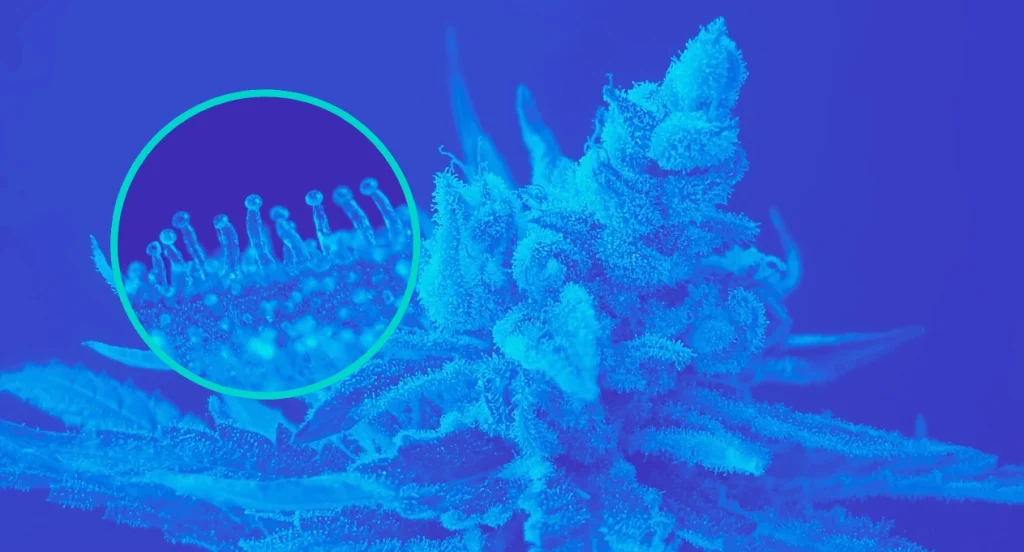
Nicht alle Trichome sind gleich, und es lohnt sich, die drei Haupttypen zu kennen, da sie in Anbauberichten, Ernteentscheidungen und Laborberichten vorkommen.
🟣 Zwiebelförmige Trichome sind die kleinsten und messen nur etwa 10 bis 15 Mikrometer, die mit bloßem Auge nicht erkennbar sind. Sie bedecken den größten Teil der oberirdischen Pflanzenteile und tragen in geringem Maße zur Gesamtproduktion von Cannabinoiden und Terpenen bei.
🟣 Kopfartige, sitzende Trichome sind die mittelgroßen, etwa 20 bis 30 Mikrometer quer, pilzförmig mit einem knolligen Kopf auf einem sehr kurzen Stiel. Sie produzieren Cannabinoide während des gesamten Lebens der Pflanze, jedoch in geringeren Konzentrationen als die größte Art.
🟣 Kopfgestielte Trichome sind die Arbeitspferde. Sie sind bis zu 500 Mikrometer hoch, gerade so ohne Mikroskop sichtbar, und bestehen aus einem langen Stiel, der von einem knolligen Kopf gekrönt ist. Ein Studie der University of British Columbia aus dem Jahr 2019 bestätigten, dass diese die reichhaltigste Quelle für THC- und CBD-produzierende Enzyme und die größten Produzenten von Terpenen sind. Wenn von “den Trichomen” die Rede ist, die einer Blüte ihre Wirksamkeit und ihr Aroma verleihen, sind fast immer diese gemeint.
Die Reife wird hauptsächlich durch die Betrachtung der köpfchengestielten Trichome unter einem Mikroskop beurteilt. Mit zunehmendem Alter der Pflanze wechseln die Köpfe von klar (früh, noch in Entwicklung) zu milchig-weiß (maximaler Cannabinoidgehalt, ideal für die meisten medizinischen Anwendungen) und schließlich zu bernsteinfarben (überreif, Cannabinoide beginnen sich zu sedierenderen Nebenprodukten abzubauen). Dieser Farbverlauf ermöglicht es einem erfahrenen Züchter, die Ernte bis auf wenige Tage genau zu timen.
🌱 Fun Fact:
Trichome kommen nicht nur bei Cannabis vor. Die meisten Blütenpflanzen verfügen in irgendeiner Form darüber. Ungewöhnlich ist jedoch, wozu Cannabis sie nutzt. Bei Cannabis haben sich Trichome als Abwehrsystem entwickelt, das klebrige, bittere und aromatische Verbindungen produziert, um grasende Tiere und Insekten abzuschrecken. Genau diese Abwehrstoffe entpuppten sich als die Cannabinoide und Terpene, die heute das Fundament einer milliardenschweren medizinischen Industrie bilden. Mit anderen Worten: Ein ganzer europäischer Markt basiert auf der chemischen Abwehr der Pflanze gegen Raupen.
Warum die Cannabisanatomie für Arbeitsplätze in der europäischen Cannabisindustrie wichtig ist
Jeder Bereich des Werks, den wir soeben besichtigt haben, lässt sich direkt einer bestimmten Tätigkeit, einer Entscheidung oder einem Dokument in der modernen europäischen Industrie zuordnen:
🟣 Kultivatoren Leben und sterben nach Knotenabstand, Kronenstruktur, Geschlechtsbestimmung, Hermaphroditismus und Trichomenreife. Jede einzelne davon ist eine tägliche anatomische Entscheidung, die den endgültigen Ertrag und das Cannabinoidprofil eines Raumes bestimmt.
🟣 Ansaugtechniker Entscheiden Sie, welche Pflanzenteile in welchen Verarbeitungsprozess gelangen. Blüten und Zuckerblätter werden ganz anders behandelt als Stängel und Fächerblätter. Zu wissen, wo sich die Trichome tatsächlich befinden, macht den Unterschied zwischen einem wertvollen Extrakt und einem teuren Fehler aus.
🟣 Qualitätskontrolle und Laborteams sich auf anatomische Fachbegriffe stützen, um Proben in einem Analysezertifikat zu beschreiben, Blütenmaterial von Schnittabfällen zu unterscheiden und zu begründen, warum eine Charge höhere Werte aufweist als eine andere.
🟣 Ärzte und Apotheker, … insbesondere in Deutschland, Großbritannien, Portugal und den Niederlanden müssen sie sich zunehmend mit den Produktformen (Blüten, Extrakte, Öle, Granulate) und deren anatomischen Ursprüngen auskennen, um die Fragen der Patienten glaubwürdig beantworten zu können.
🟣 Compliance- und Compliance-Beauftragte tätig bei EU-GMP und GACP Lesen Sie die Standardarbeitsanweisungen (SOPs) für Anbau und Verarbeitung, in denen jeder dieser Begriffe vorkommt. Eine falsche Darstellung der biologischen Eigenschaften der Pflanze in den Unterlagen ist einer der schnellsten Wege, ein Audit nicht zu bestehen.
Das ist der Grund, warum Anatomie so weit oben in dieser Reihe steht. Es ist kein akademischer Umweg. Es ist die gemeinsame Sprache, die es einem portugiesischen Züchter, einem niederländischen Extraktor, einem deutschen Apotheker und einem britischen Compliance-Beauftragten ermöglicht, über dieselbe Pflanze zu sprechen und dasselbe zu meinen.
In den nächsten Artikeln unserer Cannabis 101-Reihe bauen wir auf diesem Fundament auf und widmen uns der Taxonomie-Debatte (Sativa, anzeigen, Ruderalis und Kultivare), den Anbaukreislauf vom Samen bis zur Ernte, die verschiedenen Produktformen, zu denen diese Blüten verarbeitet werden, und schließlich die Qualitätssysteme, die das Ganze zu einem regulierten europäischen Arzneimittel machen.
Häufig gestellte Fragen
Die Hauptteile einer Cannabispflanze sind: Wurzeln, Stamm, Blätter, Blütenstände (Buds) und Samen (falls vorhanden).
Jede Cannabispflanze ist um fünf allgemeine Strukturen aufgebaut, die unabhängig vom Geschlecht vorhanden sind: Wurzeln (eine Pfahlwurzel für samenbasierte Pflanzen, plus ein breiteres faseriges Netzwerk), die Stamm, Knoten und Internodien, Fächerblätterund Blumen. In weiblichen Pflanzen entwickeln sich die Blüten zu harzreichen Knospen bestehend aus Hochblätter (oft Kelche genannt), Stempel mit ihrem Stigmataund Zuckerblätter, alle mikroskopisch beschichtet Trichome.
Was ist der Unterschied zwischen männlichen und weiblichen Cannabispflanzen?
Cannabis ist zweihäusig, was bedeutet, jede Pflanze ist entweder männlich oder weiblich. Männliche Pflanzen produzieren Pollensäcke und sehr wenige Cannabinoide und werden nicht zur Herstellung von Medizin verwendet. Weibliche Pflanzen produzieren die dichten, harzigen Blüten, in denen fast alle Cannabinoide und Terpene der Pflanze konzentriert sind. Jeder medizinische Anbau in Europa ist weiblich.
Was sind Trichome und warum sind sie wichtig?
Trichome sind mikroskopisch kleine pilzförmige Drüsen auf der Oberfläche der weiblichen Blüte, die die körpereigene Pflanze synthetisieren und speichern Cannabinoide und Terpene. Sie kommen in drei Haupttypen vor: knollenförmig, köpfchenförmig-unbehaart und köpfchenförmig-gestielt. Der größte köpfchenförmig-gestielte Typ produziert den Großteil des THC, CBD und der Terpene, und ist das, was ein Züchter unter dem Mikroskop beobachtet, um die Erntezeit zu bestimmen.
Was ist eine Cola?
A Cola Die Blütenstand von Blumen ist die Ansammlung von Blumen an der Spitze eines Hauptstammes oder Zweiges. Die größte, ganz an der Spitze der Pflanze, wird als die sogenannte Blütenstand bezeichnet. Hauptsache oder apikale Cola. Colas entwickeln sich dort, wo die Pflanze das meiste Licht erhält, und weisen die höchsten Harzkonzentrationen auf.
Ist ein Hochblatt dasselbe wie ein Kelch?
Nicht wirklich. In der klassischen Botanik, die Kelch ist der Ring aus grünen Kelchblättern an der Basis einer Blüte. Cannabis hat keinen echten Kelch in diesem Sinne. Die tränenförmige Struktur, die die Industrie als “Kelch” bezeichnet, ist eigentlich ein Hochblatt, ein modifiziertes Blatt, das die Samenanlage umhüllt und mit Trichomen bedeckt ist. Beide Begriffe werden in der Praxis synonym verwendet, aber “Hochblatt” ist der botanisch korrekte Fachbegriff.
Was ist Sinsemilla?
Sinsemilla (Spanisch für “ohne Samen”) ist der Begriff für hochpotente, unbestäubte weibliche Blüten. Sie ist der Standard für alle medizinischen und Premium-Cannabis-Sorten, da eine bestäubte weibliche Pflanze aufhört, Harz zu produzieren und ihre Energie stattdessen in die Samenproduktion umleitet.
Referenzen
- Anatomie der Cannabispflanze: von den Wurzeln bis zu den Stempeln (Sensi Seeds)
- Cannabis-Pflanzenanatomie und Infografik (Die Kanne)
- Anatomie der Cannabispflanze verstehen: Teile der Pflanze (Cannabis & Glas)
- Cannabis-Pflanzenanatomie-Leitfaden: Teile erklärt (Veriheal)
- Cannabispflanzen-Anatomie von der Samen bis zu den Trichomen (Dutch Passion)
- Im Inneren der Cannabis-Cola: Experten-Deep-Dive Triminator
- Was sind Cannabistrichome? (Technologie-Netzwerke)
- Entwicklung, Morphologie und Reifung von Drüsenhaaren in THC-reichen Blütenständen von Cannabis sativa L. (Journal of Cannabis Research, PMC, 2023, einschließlich der UBC-Erkenntnis von 2019 zu kopfförmigen Trichomen als den reichhaltigsten Cannabinoidproduzenten)
- Trichome von Cannabis sativa L. (Cannabaceae) (ResearchGate)
- Die Geschichte des Cannabis: 10.000 Jahre Medizin, Prohibition und Wiederbelebung (Lumino, Cannabis 101, Artikel 1)
- THC, CBD und Terpene: die Chemie hinter Cannabis (Lumino, Cannabis 101, Artikel 3)




 English (UK)
 Deutsch
Ein Kommentar