

Every consumable considered 'ordinary' today was once treated as a threat.
Did you know that…
- Coffee was punishable by death in 16th-century Istanbul?
- Gin was blamed for the near-collapse of 18th-century London?
- Alcohol was illegal across America for thirteen years?
- Tobacco was endorsed by doctors in medical journals until the 1950s?
Three things worth knowing before you decide what you think about cannabis:
- The evidence is not on the side of the stigma. A 2010 Lancet study ranking twenty drugs across sixteen categories of harm placed alcohol first, tobacco sixth, and cannabis eighth. The two most normalised consumables in European life sit above cannabis on a peer-reviewed harm index.
- Prohibition ends the same way every time. Coffee bans were replaced by taxation. American Prohibition ended when organised crime outgrew the legal market. Gin was tamed by licensing, not banning. Regulated markets win because they are more governable than illicit ones, not because attitudes shift first.
- Cannabis is moving fast by historical standards. Coffee took four centuries to normalise. Tobacco is still being restricted sixty years after its watershed evidence report. Cannabis prohibition began in the late 1920s and has been unwinding across Europe for roughly the last ten years. Germany reformed in 2024. Fourteen or more European countries now permit medical access. The European market is projected to reach €2 to 4 billion by 2028.
The rest of this piece is the long version, with the specific stories, dates and sources. If you only remember one line, make it this one: the stigma has not yet caught up with the regulation, and it never does, on any of these substances, until long after the regulation has already moved.
In 1511, the governor of Mecca, Khair Beg, banned coffee because he was worried about what was happening in the coffeehouses. Not the drink itself. The gatherings. He feared that political conversation, satire and criticism of authority were flourishing over roasted beans, and that this would end badly for the ruling class.
True, he was correct about the coffeehouses, but he was also wrong about the coffee itself – the drink you probably just sipped on this morning.
We open with this because the story of medical cannabis in Europe is not, in the long view, an unusual one. Every consumable now considered ordinary was once treated as a threat. The question worth sitting with is why cannabis still carries a stigma that its actual risk profile does not support, how long these things typically take to resolve, and where in that arc European medical cannabis actually sits today.
The harm-to-stigma mismatch
Let’s start with what the evidence actually says.
In 2010, the former chair of the UK government’s Advisory Council on the Misuse of Drugs, Professor David Nutt, and colleagues published a multicriteria decision analysis in The Lancet ranking twenty drugs across sixteen categories of harm to users and to wider society.
- Alcohol came first. Not first among legal drugs. First overall. Ahead of heroin, ahead of crack cocaine.
- Tobacco ranked sixth.
- Cannabis ranked eighth.
The two most heavily normalised consumables in European life sit above cannabis on a peer-reviewed harm index. That is the mismatch this article is about.
Coffee: banned for what it did to conversation

Coffee was first cultivated in the Ethiopian and Yemeni highlands around the 9th to 15th centuries and spread through the Arab world before reaching Europe in the 17th century. Khair Beg’s 1511 ban in Mecca was the first of many. Ottoman sultans Murad III (1578) and Mehmed III both moved against coffee and the coffeehouses that had spread across Istanbul, arguing at various times that coffee was intoxicating, that roasting it made it the equivalent of consuming charcoal – which was forbidden, and that public coffeehouses fostered sedition. Under some rulers, being caught drinking coffee in public in Istanbul was punishable by death. By the end of the 16th century the Ottoman court had appointed an official coffee maker, and the coffeehouses were back.
Europe was not more relaxed. In 1746, the Swedish crown banned coffee and tea outright, citing “the misuse and excesses” of both, and empowered officials to fine offenders and confiscate their cups and dishes. Historians read the ban as a mix of protectionism for locally produced beer (as beer generated tax revenue for the crown), suspicion of the foreigners who had first imported the drink, and unease at the sort of intellectuals who kept gathering in cafés.
The most famous chapter comes a generation later. King Gustav III of Sweden, convinced coffee was slowly killing his subjects, is said to have commuted the death sentences of a pair of identical twins on the condition that one drink three pots of coffee a day for life and the other drink the same in tea. Gustav wanted his suspicions confirmed. He was assassinated in 1792. The tea drinker died first, at 83. The coffee drinker outlived them both. The story may be apocryphal, but it survived because it captured something true about how these debates went: the certainty was on the wrong side.
In Prussia, Frederick the Great banned home coffee roasting in 1781 and gave the trade to a royal monopoly, arguing coffee weakened the constitution and that his subjects should drink beer, on which the state had a strong tax interest.
📊 Coffee's Timeline:
Around 400 years from Ethiopian highlands to global staple, with roughly 300 years of intermittent bans clustered between 1511 and 1817. Every ban invoked a mix of moral concern, medical claim (usually wrong), and threat to a state-taxed alternative (usually beer).
Normalisation happened in three stages, not one.
- First, the bans became unenforceable – coffee could be roasted in any household and any back-room café, so prohibition simply pushed the trade underground.
- Second, states realised that a licensed and taxed coffee market generated revenue that a banned one did not; the Ottoman court appointed an official coffee maker by the late 16th century, and Prussia’s royal monopoly quietly gave way to open trade in the 19th.
- Third, colonial supply chains through Brazil, Java and East Africa dropped the price and turned coffee from a suspicious import into a daily European staple.
🌱 The Cannabis Parallel:
Moral prohibitions rarely die because attitudes shift first; they die because governments realise that a regulated, taxed market is more governable than an unregulated one.
Alcohol: the oldest arc of all

Humans have been fermenting things for a very long time. Chemical residues on Neolithic pottery from Jiahu in China’s Henan province show a fermented drink of rice, honey, hawthorn and grapes dating to around 7000 BC. Wine production in the Caucasus dates to roughly 6000 BC, and by the third millennium BC, beer was a dietary staple in Mesopotamia. For most of human history, alcohol was not merely legal. It was often safer to drink than the local water, it carried religious and social weight, and it went essentially unregulated for thousands of years.
Serious restriction is comparatively modern. Two notable examples make the point.
The first was the London Gin Craze. Cheap grain and unlicensed distilling turned early 18th-century London into what historians describe as an epidemic of binge drinking. In 1723, the average Londoner was estimated to be drinking a pint of gin a week; in the worst neighbourhoods, one house in five was a gin shop. William Hogarth’s 1751 engraving Gin Lane, showing a syphilitic mother dropping her baby from her lap while the neighbourhood collapses around her, was published in support of the Gin Act of that year, which restricted sales to licensed premises. Production halved within twelve months. Gin was not banned for being unhealthy in some abstract sense. It was restricted because it was cheap, unlicensed and everywhere.
The second was American Prohibition. From January 1920 to December 1933, the Eighteenth Amendment and the Volstead Act banned the manufacture, sale and transport of alcohol across the United States. Thirteen years. The ban was repealed when it became clear that the illegal market had outgrown the legal one and organised crime had scaled around it.
📊 Alcohol's Timeline:
Roughly 9,000 years from the first ferments to the first serious modern restrictions, then two significant clampdowns both driven by real social harms and both resolved by moving to licensed, taxed production rather than outright bans.
- The London Gin Craze was tamed by the 1751 Gin Act, which did not ban gin but required distillers and retailers to hold licences, pay excise duties, and operate from fixed premises; illegal gin shops closed, licensed trade grew, and consumption normalised within a generation.
- American Prohibition ended more dramatically. Congress ratified the 21st Amendment on 5 December 1933, repealing the 18th, after President Roosevelt had already signed the Cullen-Harrison Act in March that year to allow 3.2 per cent beer. The drivers were straightforward: lost tax revenue during the Depression, evidence that Prohibition had not meaningfully reduced consumption, and the visible scale of organised crime that had built itself around the illegal supply. What replaced Prohibition was not free-for-all alcohol; it was the modern regulated state-licensing system that still governs the industry today.
🌱 The Cannabis Parallel:
The current European move to legal medical cannabis is being made on precisely the same reasoning: illicit cannabis markets already exist across the continent, product quality is unverified, distribution channels are often unsafe, and the state collects no tax. Building a regulated legal industry is not primarily an ethical decision. It is the same decision Congress made in 1933.
Tobacco: the reverse arc

Tobacco is the useful counter-example, because it runs in the opposite direction.
Indigenous communities in the Americas were smoking and chewing tobacco in religious and medicinal contexts from around 1 BC, treating the plant as sacred. Columbus’s crew brought it back to Spain in 1492. By 1571, European physicians were publishing treatises claiming tobacco could cure conditions ranging from toothache to cancer, and by the mid-1500s it was one of the most profitable exports from the Spanish and Portuguese colonies. It took roughly sixty years from Columbus for tobacco to become a European mainstream product, and it remained essentially unrestricted for another four centuries.
Doctors advertised specific cigarette brands in medical journals well into the 1950s. Camel ran its “More doctors smoke Camels than any other cigarette” campaign into the mid-1950s. Physicians appeared in adverts holding cigarettes, endorsing brands by name, in publications aimed at other physicians. This was normal.
That world ended on 11 January 1964, when US Surgeon General Luther Terry released Smoking and Health, the first federal report to synthesise the evidence on smoking. Its conclusions were unambiguous. Cigarette smoking was causally related to lung cancer in men, with average smokers carrying a nine to ten times higher risk than non-smokers, and it was a probable cause of lung cancer in women and the leading cause of chronic bronchitis. The report held smoking responsible for a 70 per cent increase in mortality among smokers versus non-smokers. Terry deliberately released it on a Saturday to minimise the effect on the stock market. It was front-page news around the world regardless.
What followed took decades, and Europe moved in parallel with the US rather than behind it.
- The UK’s Royal College of Physicians had published its own Smoking and Health report in March 1962, two years before Terry, and Britain banned cigarette advertising on television in 1965.
- The European Community banned tobacco advertising on television across all member states in 1989 (Television Without Frontiers Directive), and extended the ban to print, radio, internet and cross-border sponsorship in 2003.
- The World Health Organization Framework Convention on Tobacco Control (WHO FCTC), the first international treaty adopted under WHO auspices, opened for signature in 2003 and entered into force in 2005.
- Ireland became the first country in the world with a comprehensive workplace smoking ban in March 2004; the UK followed between 2006 and 2007; France, Italy, Spain and most other member states within a similar window.
- The EU Tobacco Products Directive (2014/40/EU) now governs graphic health warnings, flavour bans and e-cigarette rules across the bloc, and plain packaging has been law in France (2016), the UK (2017) and Ireland (2018).
📊 Tobacco's Timeline:
Roughly 2,000 years from indigenous ceremonial use to European mainstream, and the route to mainstream is worth being clear about, because tobacco never had to be legalised. It was profitable from the moment Columbus’s crew brought it home. Spanish and Portuguese colonial economies built themselves around it. European physicians in the late 1500s published treatises claiming medicinal benefits, giving tobacco medical legitimacy before anyone questioned whether it deserved it.
By the 20th century, cigarette companies were the largest advertisers in the West, and doctors themselves were paid to endorse specific brands in medical journals.
The 1964 Surgeon General’s report did not make tobacco illegal; it made tobacco knowable. What followed was a slow, evidence-led tightening — labelling in 1965, TV and radio ad bans in 1970, the WHO Framework Convention in 2005, plain packaging from 2012 onwards — that has never crossed into prohibition.
There is a second, more recent chapter worth noting…
The same companies that built the 20th-century cigarette business — Philip Morris International, British American Tobacco, Japan Tobacco, Altria — have spent the last decade pivoting away from combustion.
Philip Morris launched IQOS, a heat-not-burn device, in 2014 and now derives a large and growing share of its revenue from smoke-free products. BAT has done the same with glo and Vuse. Nicotine pouches (Zyn, Velo) are the fastest-growing segment in the category.
The industry has now diversified into product forms with different risk profiles, and the regulators are following the same pattern – different rules for combustible cigarettes, heated tobacco, vapes and pouches, rather than a single blanket policy for the whole category.
🌱 The Cannabis Parallel:
The tobacco arc is what “successful normalisation of a scheduled substance” ends up looking like in the long run. It becomes ordinary, then evidence sharpens, then regulation catches up.
Additionally, cannabis has already diversified in exactly the same direction. Dried flower is only one product form. Oils and tinctures for sublingual dosing, edibles, transdermal patches, topicals, capsules, and vape cartridges each carry a different risk and experience profile, and European medical frameworks are already writing separate rules for each.
The regulated endpoint for cannabis, as for tobacco, is not stigma, nor is it one product with one rule. It is a category of products with a graded set of regulations, and honest labelling at every step.
Psychedelics: the arc cannabis is now on

For those unfamiliar with this category, “Psychedelics” is a shorthand for a group of psychoactive compounds, most of them serotonin-system modulators, that alter perception, mood and thought. The classical set includes psilocybin (the active compound in psychoactive mushrooms), LSD (lysergic acid diethylamide), DMT (dimethyltryptamine, the active compound in ayahuasca), and mescaline (found in peyote).
Most of them have been used in indigenous religious and healing traditions for a very long time. Rock paintings of psychoactive mushrooms in North Africa date to around 7000 BC, and the Aztecs called them teonanácatl, or “flesh of the gods”.
The modern chapter is short. Swiss chemist Albert Hofmann synthesised LSD at Sandoz in 1938 and accidentally discovered its psychoactive effects in 1943; he isolated psilocybin in 1958. Psychedelics were legal, then heavily researched in psychiatry through the 1950s and 1960s, then criminalised in the 1970s under a wave of drug-scheduling reforms driven more by counterculture politics than by clinical evidence.
The reopening has moved faster in Europe than most people realise. Switzerland has run a limited medical-access programme for MDMA, LSD and psilocybin since 2014, allowing authorised physicians to treat patients with treatment-resistant depression, post-traumatic stress disorder and anxiety disorders under strict oversight; more than 700 patients had been treated by 2024. Germany went further in July 2025, when the Federal Institute for Drugs and Medical Devices (BfArM: Bundesinstitut für Arzneimittel und Medizinprodukte) approved the EU’s first Compassionate Use Programme for psilocybin, allowing adults with treatment-resistant depression to receive therapy at the Central Institute of Mental Health in Mannheim and a second site in Berlin. In May 2025, the Czech Republic’s Chamber of Deputies voted 142 to legalise psilocybin therapy in psychiatric hospitals and clinics from 2026, which if confirmed by the Senate will make Czechia the first EU member state to broadly legalise a psychedelic medicine.
Outside Europe, the same picture is repeating. Psilocybin and MDMA (3,4-methylenedioxymethamphetamine) have both received Breakthrough Therapy Designation from the US Food and Drug Administration, psilocybin for treatment-resistant depression and MDMA for post-traumatic stress disorder. In July 2023, Australia became the first country to reclassify both as prescribable medicines under federal health policy. Oregon opened its state-regulated psilocybin service programme in January 2023, and Colorado issued its first medical psilocybin licences in March 2025 (Healing Advocacy Fund, 2025).
📊 Pyschedelics' Timeline
Around 9,000 years of indigenous ceremonial use, roughly 30 years of legal modern scientific research (1938 to the early 1970s), and then a 50-year restriction now unwinding on the basis of clinical evidence.
The re-legalisation mechanism is a good template to watch, and it looks strikingly similar to the cannabis one. It has three moving parts:
- The first is regulator-issued Breakthrough Therapy Designation from the US FDA for psilocybin and MDMA, and, on the European side, national compassionate-use approvals like Germany’s July 2025 psilocybin programme.
- The second is jurisdictional first-movers legislating ahead of federal or EU-wide consensus: Switzerland (2014), Australia (2023), Oregon (2023), Colorado (2025), the Czech Republic (2026).
- The third is patient advocacy, particularly from military veterans and treatment-resistant depression patients, which has changed the political conversation in ways the 1960s counterculture never did.
🌱 The Cannabis Parallel:
Psychedelics today are roughly where medical cannabis was in the mid-2010s, and they are moving through the same three doors – clinical evidence, jurisdictional first-movers, and organised patient advocacy.
Germany, having led the EU on medical cannabis in 2024, is also the first EU country to approve compassionate use of psilocybin in 2025. That is not a coincidence. The same regulatory apparatus that opened the door to one is now opening it to the other.
Opioids: the case worth sitting with
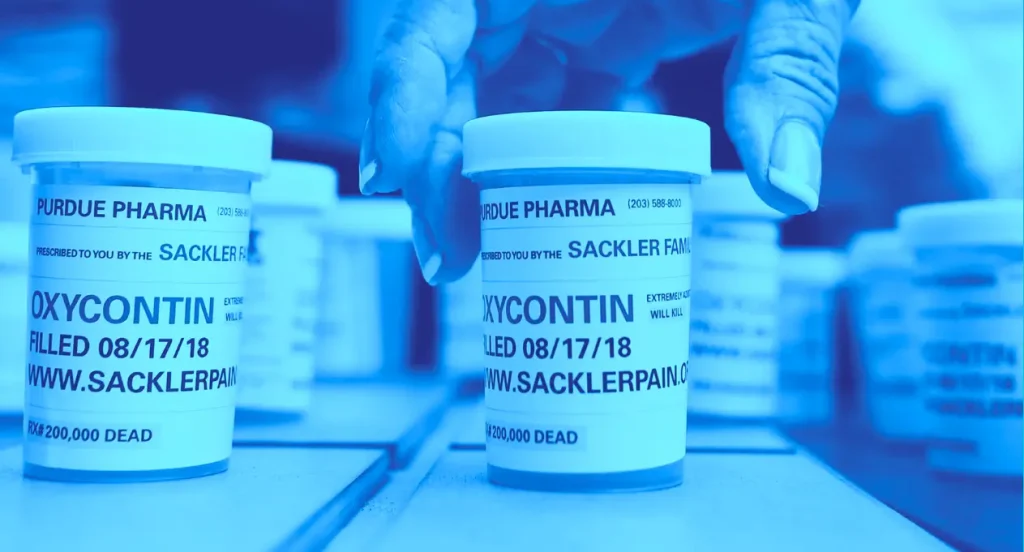
Opioids deserve their own section, because they are the most important counter-story here. This is not a parallel arc. It is the arc we should be careful about.
In December 1995, the US Food and Drug Administration approved OxyContin, an extended-release formulation of oxycodone, on the theory that its twelve-hour release profile would make it less prone to abuse than immediate-release opioids. Purdue Pharma marketed the drug aggressively, and internal training instructed sales representatives that the risk of addiction was minimal.
As one might expect, US prescriptions for non-cancer chronic pain rose from around 670,000 in 1997 to 6.2 million by 2002. Purdue and members of the Sackler family have since paid billions in settlements, and the US Centers for Disease Control and Prevention has attributed the first wave of an opioid epidemic that has since claimed several hundred thousand American lives to the prescribing patterns of this period.
The lesson we can draw from the opioid crisis is specific, not general. The failure had identifiable causes: weak underlying evidence, aggressive marketing to physicians, and a regulator that did not enforce the boundaries of the label it had granted. Any one of those factors alone might not have produced a crisis. Together they did.
Where cannabis fits in all this is a positive one – most of the world’s cannabis frameworks already have those failure points directly in view. Prescribing sits with specialist physicians in most jurisdictions. Direct-to-consumer marketing is heavily restricted. Product standards are set by pharmaceutical-grade EU-GMP rules.
Where cannabis actually sits in this story
Cannabis has been cultivated for around 10,000+ years, primarily in what is now China, Mongolia and Kazakhstan. Its earliest documented medical use is attributed to the Chinese Emperor Shen Nung around 2700 BC, who recorded cannabis as a treatment for a range of ailments; his teachings later appeared in the Shen Nung Pen-ts’ao Ching, a second-century herbal.
Prohibition is the historical anomaly, not the norm – cannabis was widely used across the ancient world, appeared in Victorian British pharmacopoeias, and was prescribed by Western physicians into the early 20th century.
The unwinding is now well underway. Europe has fourteen countries with functioning medical cannabis frameworks, multiple adult-use governmental experiments, and over 1 million active patients in Germany alone. In North America, the US industry generated $33.8 billion in retail sales in 2025 across 24 adult-use states and 38 medical states, alongside Canada’s federally legal market. Israel now has more than 137,000 licensed medical patients, the highest per-capita rate in the world. And Thailand went from execution for cannabis trafficking to a fully-fledged legal market in four years.
Global restriction is recent – lasting merely around 90 years.
- The UK’s Dangerous Drugs Act banned cannabis in 1928.
- The US Marihuana Tax Act of 1937 effectively criminalised it in the United States, in a campaign led by Federal Bureau of Narcotics commissioner Harry Anslinger and built on a mix of racialised propaganda and industrial lobbying.
- The United Nations Single Convention on Narcotic Drugs in 1961 classified cannabis alongside heroin in its strictest schedule, and the 185 signatory countries committed to align domestic law accordingly.
How this compares.
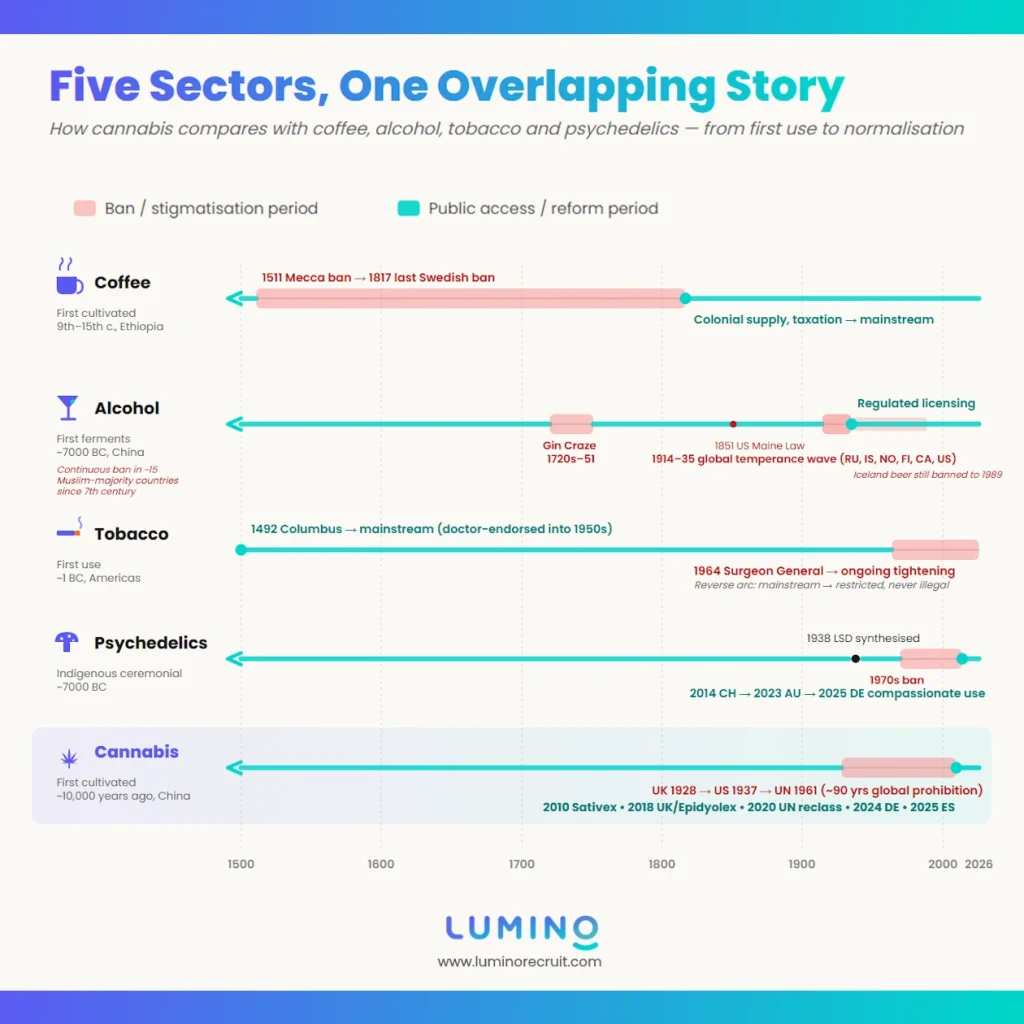
Cannabis’s discovery-to-mainstream arc was roughly 5,000 years; its restriction has lasted around 90; its unwinding is now roughly ten years old.
That is a fast tempo by historical standards.
- Coffee took four centuries to resolve.
- Alcohol restrictions unwound in thirteen years for US Prohibition, and never fully across gin licensing.
- Tobacco is still tightening, sixty years after its watershed report.
- Psychedelics are ten years behind cannabis on the same curve.
The mechanism of cannabis’s return follows the same three-part template that reopened psychedelics.
- The clinical evidence has been accumulating for decades and is now dense enough for pharmaceutical-grade products. The UK’s MHRA (Medicines and Healthcare products Regulatory Agency) approved Sativex, a whole-plant cannabis extract for multiple sclerosis, in 2010 – the first cannabis-based medicine in Europe. The EMA (European Medicines Agency) followed with Epidyolex for childhood epilepsy in 2019.
- Jurisdictional first-movers (i.e., Germany, the UK, France, Spain, Malta) have created working medical frameworks that other EU member states are now copying.
- And patient advocacy, particularly around paediatric epilepsy, chronic pain and multiple sclerosis, has moved public opinion in ways that no counterculture argument ever did. In 2020, the UN Commission on Narcotic Drugs voted to remove cannabis from the strictest schedule of the 1961 Convention – the first international-treaty-level acknowledgement that the 1961 categorisation was wrong.
Where cannabis is treated differently.
- One would be that cannabis is a botanically complex, living product rather than a single synthesised molecule. A typical pharmaceutical contains one active compound at a known dose. Cannabis contains more than a hundred cannabinoids, such as THC (tetrahydrocannabinol) , CBD (cannabidiol), THCV (tetrahydrocannabivarin), CBN (canabinol) and CBG (cannabigerol) plus hundreds of terpenes and flavonoids that interact with each other to produce the therapeutic effect. This interaction is often called the entourage effect, and it means the plant works as a system, not as a single input. Two consequences follow. Standardisation is harder, because any change in cultivar, growing conditions or extraction method shifts the whole profile. And regulatory fit is slower, because the pharmaceutical model was built around single-molecule dosing, not around whole-plant preparations with dozens of interacting components.
- Another would be that cannabis reform proceeds on two parallel tracks — medical access and adult-use reform — that alcohol, tobacco and psychedelics never had to reconcile simultaneously. Coffee had no medical arm. Tobacco has no serious medical case. Psychedelics are being reopened only for supervised clinical use with some very promising results. Cannabis is the only substance in this story trying to normalise both routes at once, and the two tracks periodically undermine each other in the public conversation.
The question is no longer whether medical cannabis becomes an ordinary category of European healthcare. It is how quickly, and who builds the credible operators inside it.
References
- Atlas Obscura (no date) In Istanbul, Drinking Coffee in Public Was Once Punishable by Death. Available at: https://www.atlasobscura.com/articles/was-coffee-ever-illegal
- Britannica (no date) Prohibition | Definition, History, Eighteenth Amendment, & Repeal. Available at: https://www.britannica.com/event/Prohibition-United-States-history-1920-1933
- Business of Cannabis (2026) EU Cannabis Regulation 2026: Country Laws, Markets & Policy. Available at: https://businessofcannabis.com/eu-cannabis-regulation/
- Cambridge (no date) A Brief History of Cannabis and the Drug Conventions, American Journal of International Law. Available at: https://www.cambridge.org/core/journals/american-journal-of-international-law/article/brief-history-of-cannabis-and-the-drug-conventions/A8547C998A1D05173495BCD6012329C0
- Cannabis Europa (2024) Medical Cannabis in Europe: Which Countries Allow It? Available at: https://cannabis-europa.com/insights/medical-cannabis-europe/
- The Cannigma (no date) History of Medical Cannabis in Ancient China. Available at: https://cannigma.com/history/the-history-of-medical-cannabis-in-ancient-china/
- Centers for Disease Control and Prevention (no date) A History of the Surgeon General’s Reports on Smoking and Health. Available at: https://www.cdc.gov/tobacco-surgeon-general-reports/about/history.html
- Cleveland Clinic Journal of Medicine (2025) Psychedelic-assisted therapy: An overview for the internist. Available at: https://www.ccjm.org/content/92/3/171
- Elios Clinics (no date) Timeline of Medical Cannabis History. Available at: https://www.eliosclinics.com/medical-cannabis-history-timeline/
- Ethics Unwrapped (no date) OxyContin & the Opioid Epidemic. University of Texas at Austin. Available at: https://ethicsunwrapped.utexas.edu/video/oxycontin-the-opioid-epidemic
- Federal Judicial Center (no date) Prohibition in the Federal Courts: A Timeline. Available at: https://www.fjc.gov/history/exhibits/prohibition-in-federal-courts-timeline
- Georgetown Law (no date) Plain Tobacco Packaging – Global Health Law Research Guide. Available at: https://guides.ll.georgetown.edu/globalhealthlaw/plaintobaccopackaging
- GovFacts (no date) How the FDA Approved OxyContin: The 1995 Decision That Started America’s Opioid Crisis. Available at: https://govfacts.org/health-healthcare/drugs-and-medications/drug-safety/how-the-fda-approved-oxycontin-the-1995-decision-that-started-americas-opioid-crisis/
- Harvard Health (2014) Surgeon General’s 1964 report: making smoking history. Available at: https://www.health.harvard.edu/blog/surgeon-generals-1964-report-making-smoking-history-201401106970
- Healing Advocacy Fund (2025) Over 28 States Have Introduced Legislation for Psilocybin Access. Available at: https://healingadvocacyfund.org/news/over-28-states-have-introduced-legislation-for-psilocybin-access
- Iguana Smoke (2026) Map of cannabis legality in Europe 2026. Available at: https://iguanasmoke.com/en/cannabis-legislation-map-legality-cannabis-europe/
- Ka’ū Coffee Mill (2023) Historic Attempts to Ban Coffee. Available at: https://kaucoffeemill.com/blogs/news/historic-attempts-to-ban-coffee
- London Museum (no date) The Gin Craze: Ruin of 1700s London. Available at: https://www.londonmuseum.org.uk/collections/london-stories/gin-craze-ruin-1700s-london/
- Medievalists.net (2025) Brewing Controversy: How Coffee Sparked Fierce Debate in the 16th Century. Available at: https://www.medievalists.net/2025/09/brewing-controversy-how-coffee-sparked-fierce-debate-in-the-16th-century/
- Mental Floss (2015) 5 Historical Attempts to Ban Coffee. Available at: https://www.mentalfloss.com/article/12662/5-historical-attempts-ban-coffee
- Nutt, D.J., King, L.A. and Phillips, L.D. (2010) ‘Drug harms in the UK: a multicriteria decision analysis’, The Lancet, 376(9752), pp. 1558–1565.
- Penn Museum (no date) The Earliest Alcoholic Beverage in the World. Available at: https://www.penn.museum/research/project.php?pid=12
- Popular Science (2020) 4 times drinking coffee was illegal — or even punishable by death. Available at: https://www.popsci.com/health/coffee-ban-history/
- Prohibition Partners (no date) Portugal Medical Cannabis Legislation & Legal Status. Available at: https://prohibitionpartners.com/european-cannabis-markets/european-medical-cannabis-legislation-map/portugal/
- Psychiatric News (2023) Australia Legalizes Psychedelics for Use in Depression, PTSD Therapy. Available at: https://psychiatryonline.org/doi/10.1176/appi.pn.2023.09.9.20
- Retreat Guru (no date) The History of Psychedelics: A Timeline of Psychedelic Drugs. Available at: https://blog.retreat.guru/the-history-of-psychedelics
- Transform (no date) A short history of the Misuse of Drugs Act. Available at: https://transformdrugs.org/mda-at-50/a-short-history-of-the-misuse-of-drugs-act
- World Health Organization (2005) WHO Framework Convention on Tobacco Control. Geneva: WHO. Available at: https://fctc.who.int/
- World History Encyclopedia (no date) A Brief History of Tobacco in the Americas. Available at: https://www.worldhistory.org/article/1677/a-brief-history-of-tobacco-in-the-americas/




 English (UK)
 Deutsch