
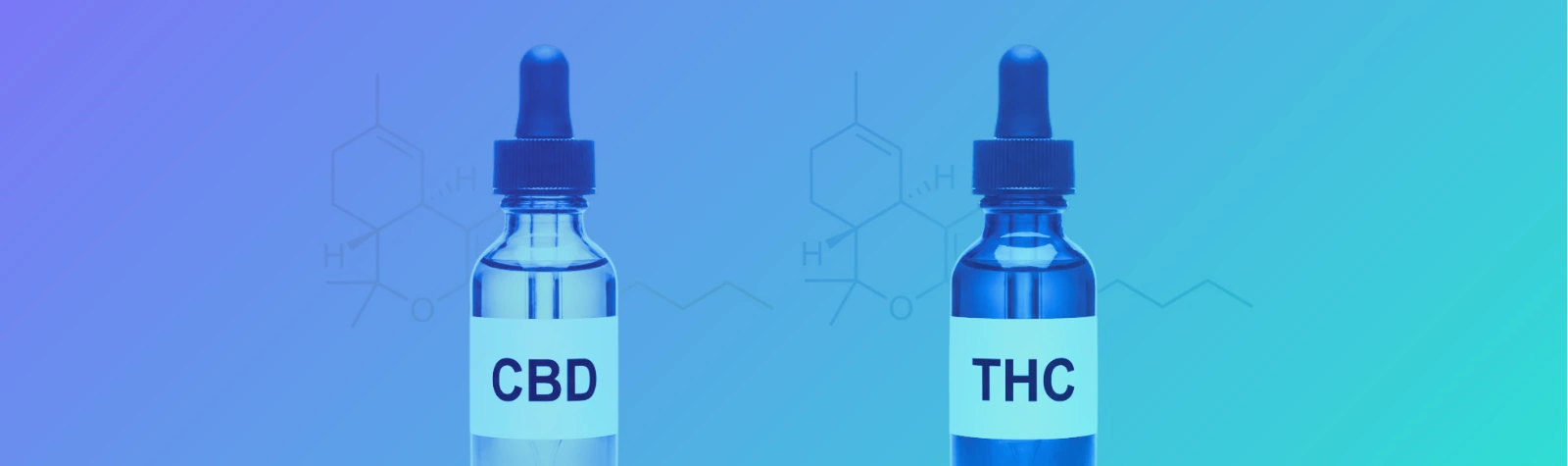
Cannabis enthält 500+ Verbindungen
Dies beinhaltet über 100 Cannabinoide wie zum Beispiel THC und CBD, plus aromatisch Terpene.
THC verursacht den “Rausch”, CBD nicht, und beides existiert nicht in ungeöffneter Blüte, bis Hitze eine Reaktion namens auslöst Decarboxylierung. Das Verständnis dieser Chemie ist die Grundlage für alles, was die moderne Cannabisindustrie tut, von der Züchtung bis zur Verschreibung.
Fragen Sie die meisten Leute, was in Cannabis enthalten ist, und Sie werden ein Wort hören: THC. Das ergibt Sinn, da es einer der am weitesten verbreiteten Begriffe im Zusammenhang mit der Pflanze ist, aber es kratzt kaum an der Oberfläche dessen, was Cannabis tatsächlich enthält. Die Cannabispflanze ist einer der chemisch komplexesten Organismen in der kommerziellen Landwirtschaft, und die von ihr produzierten Verbindungen sind der Grund, warum es heute eine ganze europäische medizinische Industrie rund um sie gibt. Wenn Sie in diese Branche einsteigen, sei es als Kandidat, Gründer oder Investor, ist die Chemie das Vokabular, das Sie nicht überspringen können. Wenn Sie es richtig machen, ergeben Produktetiketten, Laborberichte und klinische Gespräche plötzlich Sinn.
Dies ist unser Leitfaden in einfacher Sprache, der erklärt, woraus Cannabis tatsächlich besteht. Keine Übertreibung, keine Couch-Lock-Klischees, nur die Wissenschaft, die zählt, erklärt für Menschen, die im Sektor arbeiten wollen, anstatt nur seine Produkte zu konsumieren.
Was sind Cannabinoide? Eine kurze Einführung
Cannabinoide sind die Stoffklasse, die Cannabis pharmakologisch interessant macht. Die Pflanze produziert mehr als 100 verschiedene Cannabinoide, und sie wirken, indem sie mit dem menschlichen Endocannabinoid-System, ein Signalnetzwerk, das hilft, Stimmung, Schmerz, Appetit, Schlaf und Immunantwort zu regulieren.
Hier ist eine Unterscheidung, die es wert ist, früh zu lernen, da sie die Leute, die die Branche kennen, von denen, die es nicht tun, trennt:
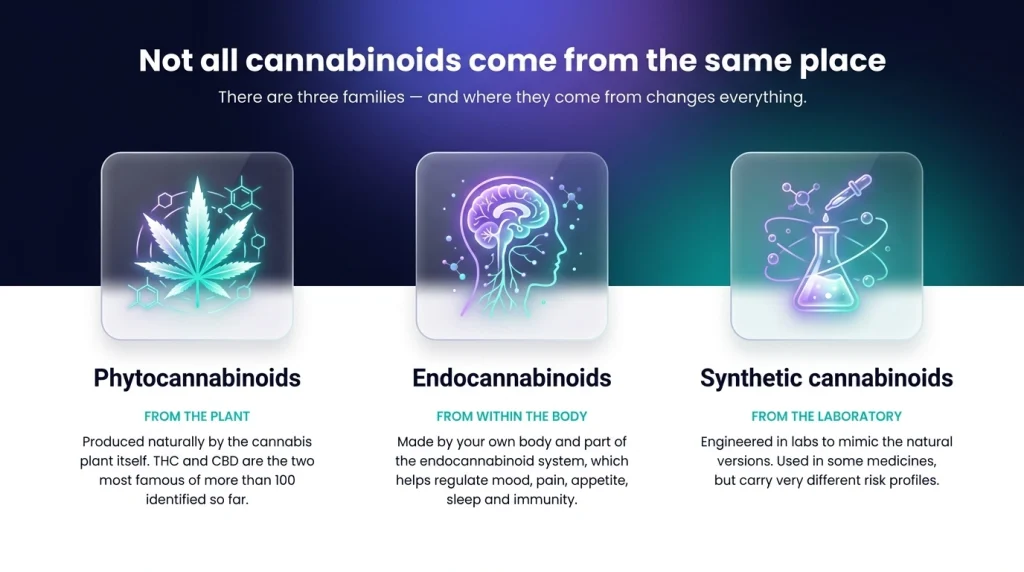
🟣 Phytocannabinoide (aus dem Griechischen Python, mit der Bedeutung von “Pflanze”) werden von der Cannabispflanze selbst hergestellt. THC und CBD sind die berühmten beiden.
🟣 Endocannabinoide (aus dem Griechischen End, bedeutet “innerhalb”) werden in Ihrem eigenen Körper hergestellt und wirken auf dieselben Rezeptoren.
🟣 Synthetische Cannabinoide werden im Labor hergestellt, um natürliche Varianten nachzuahmen und bergen sehr unterschiedliche Risikoprofile.
Wenn Menschen im Wellness-Kontext über Cannabinoide sprechen, meinen sie fast immer Phytocannabinoide. Auf diese werden wir uns hier konzentrieren.
THC vs. CBD: die beiden Verbindungen, die die meiste Aufmerksamkeit bekommen
Von diesen Phytocannabinoiden, die die Pflanze produziert, dominieren zwei die Diskussion: Tetrahydrocannabinol (THC) und Cannabidiol (CBD). Verstehen des Unterschied zwischen ihnen ist das mit Abstand Nützlichste, was ein Neuling lernen kann.
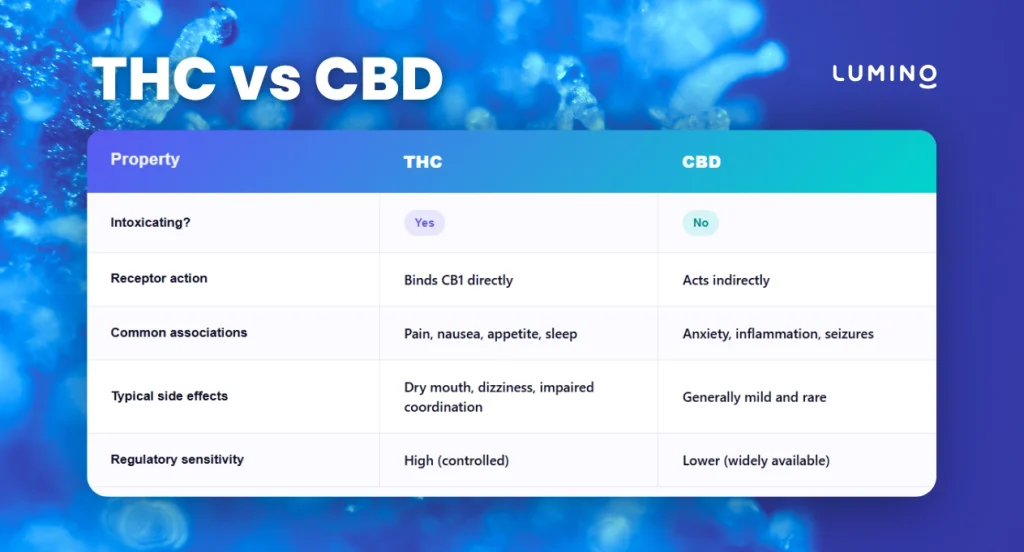
THC ist der primäre psychoaktiv verantwortlich für die berauschende Wirkung, die gemeinhin mit Cannabis in Verbindung gebracht wird. Es kann die Wahrnehmung, die Stimmung und die motorischen Funktionen verändern, insbesondere in höheren Dosen. Dies geschieht durch direkt binden an CB1-Rezeptoren im Gehirn als Partieller Agonist.
CBD, in seiner reinen Form keine berauschende Wirkung hat. Anstatt sich stark an denselben Rezeptoren zu binden, beeinflusst es das System indirekter, weshalb es breit für beruhigende, entzündungshemmende und Wellness-Anwendungen eingesetzt wird, ohne einen Rausch zu erzeugen. Ein gereinigtes CBD-Medikament ist sogar in Großbritannien und Europa zugelassen für sicher schwer, therapieresistent Formulare von Epilepsie.
Die beiden sind keine Rivalen. Bei Medizinprodukten werden sie häufig kombiniert, und das Verhältnis zwischen ihnen, oft geschrieben als so etwas wie 10:10 oder 20:1, ist eines der ersten Dinge, die ein verschreibender Arzt oder ein Produktentwickler berücksichtigt.
🌱 Fun Fact:
Dein Körper stellt seine eigenen Cannabinoide her. Eines davon, Anandamid, leitet seinen Namen vom Sanskrit-Wort ab Ananda, was “Glückseligkeit” bedeutet. Cannabis hat das System, auf das es wirkt, nicht erfunden; es hat lediglich die Schlüssel entliehen.
Die rohe Wahrheit: Decarboxylierung und warum frisches Cannabis Sie nicht high macht
Hier ist eine Tatsache, die fast jeden überrascht, der neu auf der Pflanze ist: Rohes, frisch geerntetes Cannabis enthält fast gar kein THC oder CBD..
Was die Pflanze tatsächlich produziert, sind die sauren Vorstufen, Tetrahydrocannabinolsäure (THCA) und Cannabidiolsäure (CBDA). In diesem rohen Zustand, THCA erzeugt keinen Rausch egal wie viel davon Sie konsumieren. Die Verbindung wird erst durch eine chemische Reaktion aktiv, die man nennt Decarboxylierung, in der Hitze eine Carboxylgruppe aus dem Molekül, wodurch Kohlendioxid freigesetzt und THCA in psychoaktives THC umgewandelt wird.
Dies geschieht immer, wenn Cannabis Hitze ausgesetzt wird: sofort, wenn eine Blüte auf eine Flamme oder einen Verdampfer trifft, und langsam mit der Zeit, wenn Pflanzenmaterial einfach bei Raumtemperatur altern gelassen wird. Das ist auch der Grund, warum man aus unbehandelten Blüten kein effektives Edible backen kann, ohne sie vorher sanft zu erhitzen. Für jeden, der in der Extraktion, Formulierung oder Qualitätskontrolle arbeitet, ist die Decarboxylierung kein triviales Thema; es ist a gesteuert Verarbeitung Schritt dass bestimmt ob a Produkt Werke als beschriftet.
Jenseits von THC und CBD: Die Cannabinoide, die es wert sind, beobachtet zu werden
THC und CBD dominieren die Unterhaltung, aber eine Handvoll Minderjährige Cannabinoide ziehen ernsthaftes kommerzielles und wissenschaftliches Interesse auf sich. Dies sind die Verbindungen, auf die Produktentwicklungsteams insgeheim für die nächste Welle von Formulierungen wetten.
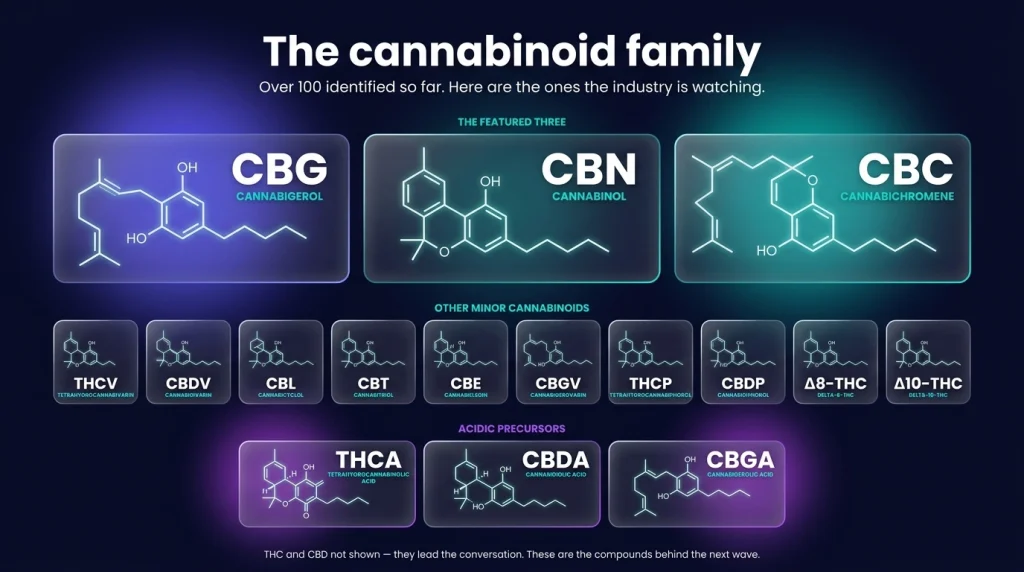
🟣 CBG (Cannabigerol) wird oft als “Mutter-Cannabinoid” bezeichnet, da andere Cannabinoide aus seiner sauren Form synthetisiert werden. Frühe Forschungsergebnisse deuten auf entzündungshemmendes und neuroprotektives Potenzial hin, und ein 2024 placebo-kontrollierte Studie fand eine Einzeldosis von 20 mg reduzierte Angstzustände bei gesunden Erwachsenen ohne jegliche Intoxikation.
🟣 CBN (Cannabinol) Formen, da THC altert und sich abbaut. Es wird weithin für Schlaf vermarktet, obwohl Systematische Übersichtsarbeit Die menschlichen Beweise für diese Behauptung bleiben dünn.
🟣 CBC (Cannabichromen) ist nicht berauschend und, nach einigen Maßstäben, das dritthäufigste Cannabinoid. Präklinische Arbeiten legen entzündungshemmende und stimmungsbezogene Effekte nahe.
Außer diesen drei produziert die Pflanze Dutzende weitere, von denen die meisten Leute noch nie gehört haben: THCV (Tetrahydrocannabivarin), CBDV (Cannabidivarin), CBL (Cannabicyclol), KVT (Cannabitriol), CBE (Cannabidiol), CBGV (Cannabigerovarin), THCP (Tetrahydrocannabiphorol), CBDP (Cannabidiphorol), Delta-8-THC und Delta-10-THC, zusammen mit den sauren Vorläufern THCA, CBDA und CBGA. Über 100 Cannabinoide wurden insgesamt identifiziert, und heute noch neue in Laboren isoliert werden.
Ein ehrliches Wort, das die meisten Cannabis-Blogs auslassen: Die Wissenschaft hinkt dem Marketing hinterher. A 2024 Übersicht über geringwertige Cannabinoide bei psychiatrischen Erkrankungen fand nur eine einzige qualifizierende klinische Studie, wenn man alle zusammenzählt. Das Potenzial ist real, aber genauso real ist die Lücke zwischen einem vielversprechenden präklinischen Ergebnis und einem nachgewiesenen menschlichen Nutzen. Genau in dieser Lücke können sich glaubwürdige europäische Betreiber differenzieren.
🌱 Fun Fact:
CBN ist nichts, was die Pflanze von sich aus herstellt. Es ist im Wesentlichen “gereiftes” THC, das Cannabinoid-Äquivalent eines Weins, der im Keller Charakter entwickelt. Altes, schlecht gelagertes Cannabis ist oft reich an CBN, weshalb es eher schläfrig als berauschend wirkt.
Terpene: Die Aromamachine von Cannabis
Wenn Cannabinoide erklären die Pharmakologie der Cannabinoide (der Wissenschaft, wie die Pflanzenstoffe mit dem Körper interagieren), Terpene erkläre seine Persönlichkeit. Das sind die aromatische organische Verbindungen, die für den Geruch und Geschmack von Cannabis verantwortlich sind, und sind nicht darauf beschränkt. Dieselben Moleküle verleihen Lavendel, Zitrusschalen und Kiefernwäldern ihren unverwechselbaren Duft.
Die Cannabispflanze produziert über 200 Terpenarten, und es ist ein spezifischer Stamm Terpenprofil, weit mehr als jedes Indica- oder Sativa-Label, Das gibt ihm ein erkennbares Aroma. Hier sind fünf der häufigsten und wo Sie ihnen sonst noch in der Natur begegnen.
Die 5 Terpene, die jede Cannabissorte prägen
Terpene sind die aromatischen Verbindungen, die Cannabis seinen Geruch, Geschmack und seine Persönlichkeit verleihen. Sie sind nicht einzigartig für Cannabis – dieselben Moleküle verleihen Lavendel, Zitrusfrüchten und Kiefernwäldern ihre charakteristischen Düfte.
Myrcen
Auch gefunden inMango, Hopfen, Thymian
Limonen
Auch gefunden inZitronen- und Orangenschale
Pinen
Auch gefunden inKiefernadeln, Rosmarin
Linalool
Auch gefunden inLavendel
Caryophyllen
Auch gefunden inSchwarzer Pfeffer, Nelken
Noch ein Vokabelstück. Wenn Terpene sich chemisch verändern, normalerweise durch Oxidation, da sie Luft oder Hitze ausgesetzt werden, sie werden Terpenoide. Die Begriffe werden oft austauschbar verwendet, aber streng genommen sind Terpene die frische, natürliche Form und Terpenoide die modifizierte Version. Die Erhaltung dieses empfindlichen Terpenprofils ist einer der Hauptgründe, warum die Extraktionsmethode so wichtig ist, ein Thema, das wir in unserer Leitfaden zur Cannabisextraktion.
Der Entourage-Effekt: Symphonie oder Marketinggeschichte?
Dies bringt uns zu der meistdiskutierten und umstrittensten Idee in der Cannabis-Chemie: dem Entourage-Effekt.
Es besagt, dass Cannabinoide und Terpene besser zusammen als isoliert wirken, wobei sie sich gegenseitig modulieren, sodass die gesamte Pflanze Effekte erzeugt, die keine einzelne gereinigte Verbindung nachahmen kann. Das Ganze ist also mehr als die Summe seiner Teile. Dies ist die wissenschaftliche Begründung für Vollspektrum Produkte, und es wird branchenweit als etablierte Tatsache wiederholt.
Jedoch, Es ist nicht geklärt. Einige Laboruntersuchungen deuten darauf hin, dass Terpene die Aktivität von Cannabinoiden subtil beeinflussen können, und die glaubwürdigste neue menschliche Beweislage, eine doppelblinde Crossover-Studie 2024–2025, fand, dass eingeatmet Limonen in Verbindung mit THC haben Angstzustände und Paranoia im Vergleich zu THC allein signifikant reduziert. Dies ist ein echter Datenpunkt zugunsten der Theorie. Aber es ist ein Terpen, ein Cannabinoid und ein Endpunkt. Mehrere andere kontrollierte Studien haben keine bedeutsame Wechselwirkung festgestellt, und eine 2025 narrativer Überblick kam zum selben Ergebnis wie seine 2024 VorgängerDer Mechanismus ist biologisch plausibel, die präklinischen Ergebnisse sind vielversprechend, und für die klinische Übertragung fehlen noch standardisierte Studien zur Bestätigung. Mit anderen Worten, die Theorie ist möglicherweise richtig, aber “jeder weiß, dass sie wahr ist” ist nicht dasselbe wie “die Daten bestätigen sie”.
Warum ist das für ein professionelles Publikum wichtig? Weil der Entourage-Effekt zur Rechtfertigung von Premiumpreisen für Vollspektrumprodukte verwendet wird. Zu wissen, dass die Wissenschaft noch offen und nicht abgeschlossen ist, ist der Unterschied zwischen einer ehrlichen Vermarktung eines Produkts und einer Übervermarktung, und in einem medizinischen Markt hat diese Unterscheidung regulatorische Bedeutung.
🌱 Fun Fact:
Das Wort “Entourage” fand 1998 durch eine wissenschaftliche Arbeit Eingang in die Cannabisforschung, wurde aber durch den Forscher Dr. Ethan Russo in einem Artikel aus dem Jahr 2011 mit dem denkwürdigen Titel “Taming THC”. Fast drei Jahrzehnte später ist die von ihm angestoßene Debatte immer noch sehr aktuell.
Warum diese Chemie für die europäische Cannabisbranche wichtig ist
Die Chemie von Cannabis ist der Grund dafür, dass es im schnell wachsenden medizinischen Markt Europas heute so viele spezialisierte Rollen gibt:
🟣 Kultivatoren auf spezifische Cannabinoid- und Terpenprofile züchten.
🟣 Ansaugtechniker wählen Sie Methoden, die diese Verbindungen schützen.
🟣 Qualitätssicherungsteams laufen Potenzprüfungen um zu bestätigen, was ein Etikett aussagt.
🟣 Apotheker und Ärzte wägen Sie THC-zu-CBD-Verhältnisse gegen die Bedürfnisse eines Patienten ab.
Jeder dieser Jobs hängt von den Grundlagen ab, die wir gerade behandelt haben.
Aber das Verständnis von Cannabinoiden, Decarboxylierung und Terpenen ist erst der Anfang. Von hier aus ist es der natürliche nächste Schritt, die Pflanze selbst in unserem Leitfaden zur Cannanbis-Pflanzenanatomie zu verstehen und zu begreifen, wie diese Verbindungen physikalisch extrahiert werden, in unserem Leitfaden zu Cannabis-Extraktionsmethoden.
Häufig gestellte Fragen
Der Hauptunterschied zwischen THC und CBD liegt in ihren psychoaktiven Wirkungen. THC (Tetrahydrocannabinol) ist die Verbindung, die für das "High"-Gefühl verantwortlich ist, das mit dem Cannabiskonsum verbunden ist. CBD (Cannabidiol) hingegen ist nicht psychoaktiv und erzeugt kein High.
THC ist die berauschende Verbindung, die einen Rausch hervorruft, indem sie sich direkt an Rezeptoren im Gehirn bindet. CBD ist nicht berauschend und wirkt indirekter, weshalb es zur Beruhigung und bei Entzündungen ohne Beeinträchtigung eingesetzt wird.
Enthält rohes Cannabis THC?
Nicht in nennenswerten Mengen. Rohes Cannabis enthält THCA, ein säurehaltiges Vorprodukt, das erst durch Erhitzen in aktivem THC umgewandelt wird, durch einen Prozess namens Decarboxylierung.
Was sind Terpene und machen sie high?
Terpene sind aromatische Verbindungen, die Cannabis seinen Geruch und Geschmack verleihen. Sie sind für sich genommen nicht berauschend, aber einige Forscher glauben, dass sie die Gesamtwirkung eines Produkts beeinflussen.
Ist der Entourage-Effekt bewiesen?
Nein. Es ist eine weit verbreitete und plausible Hypothese, und eine Humanstudie von 2024–2025 zu Limonen und THC hat ihr glaubwürdige neue Unterstützung verliehen, aber die breitere Evidenz bleibt gemischt und oft von geringer Qualität. Sie sollte als vielversprechend und nicht als etabliert betrachtet werden.
Was sind Cannabinoide in geringen Mengen?
Dies sind Cannabinoide, die in geringeren Mengen als THC und CBD vorhanden sind, wie z. B. CBG, CBN und CBC. Mehrere zeigen in der frühen Forschung therapeutisches Potenzial, obwohl robuste klinische Beweise am Menschen noch begrenzt sind.
Referenzen
- Cannabis, eine komplexe Pflanze: über 100 identifizierte Cannabinoide (Nationalbibliothek für Medizin)
- Wie THC wirkt: Erklärung der Ligandenaffinität und des partiellen Agonismus am Cannabinoidrezeptor 1 (PMK)
- Epidyolex – EPAR der Europäischen Arzneimittelagentur (EMA)
- Das Endocannabinoid-System: Ein Überblick (Nationalbibliothek für Medizin)
- CBD vs THC: Unterschiede, Vorteile und Effekte (Healthline)
- Was ist Decarboxylierung und warum braucht Cannabis sie? (Leafly)
- Therapeutisches Potenzial von sauren Cannabinoiden: ein Update (Journal of Cannabis Research, Springer)
- Können Sie den Säuretest bestehen? Kritische Überprüfung und neuartige therapeutische Perspektiven von Δ9-Tetrahydrocannabinolsäure A (Cannabis und Cannabinoid-Forschung)
- Nebensächliche Cannabinoide erklärt: CBG, CBN, THCV, CBC und CBDV (Die Kanne)
- Cannabis-Sativa-Terpene sind cannabimimetisch und steigern selektiv die Cannabinoid-Aktivität (Scientific Reports, Nature)
- Der Entourage-Effekt bei medizinischen Cannabisprodukten: Eine umfassende Übersicht (Pharmazeutika, MDPI, 2024)
- THC zähmen: Potenzielle Cannabis-Synergie und Phytocannabinoid-Terpenoid-Entourage-Effekte (Russo, British Journal of Pharmacology)
- Terpene in Cannabis sativa – Vom Pflanzengenom zum Menschen (Pflanzenwissenschaften, ScienceDirect)
- Eine umfassende phytochemische Analyse von Terpenen, Polyphenolen und Cannabinoiden bei 9 kommerziellen Sorten von Cannabis sativa L. (PMK)
- Terpene vs. Terpenoide: Unterschiede und Gemeinsamkeiten (Leafwell)
- Was ist der Entourage-Effekt und ist er vorteilhaft? (Medical News Today)
- Der ‘Entourage-Effekt’ – was wir nicht wissen, wie Cannabis wirkt Das Gespräch
- Phytochemische Modulatoren der Nozizeption: Ein Überblick über Cannabis-Terpene bei chronischen Schmerzsyndromen (PMC, 2025)
- Cuttler et al., Akute Effekte von Cannabigerol auf Angst, Stress und Stimmung: eine doppelblinde, placebokontrollierte, Crossover-Feldstudie (Scientific Reports, Nature, 2024)
- Corroon, Cannabinol und Schlaf: Trennung von Fakten und Fiktion (Cannabis and Cannabinoid Research, 2021)
- Therapeutisches Potenzial von Cannabinoiden-Nebenprodukten bei psychischen Störungen: eine systematische Überprüfung (Europäische Neuropsychopharmakologie, 2024)


 English (UK)
 Deutsch