

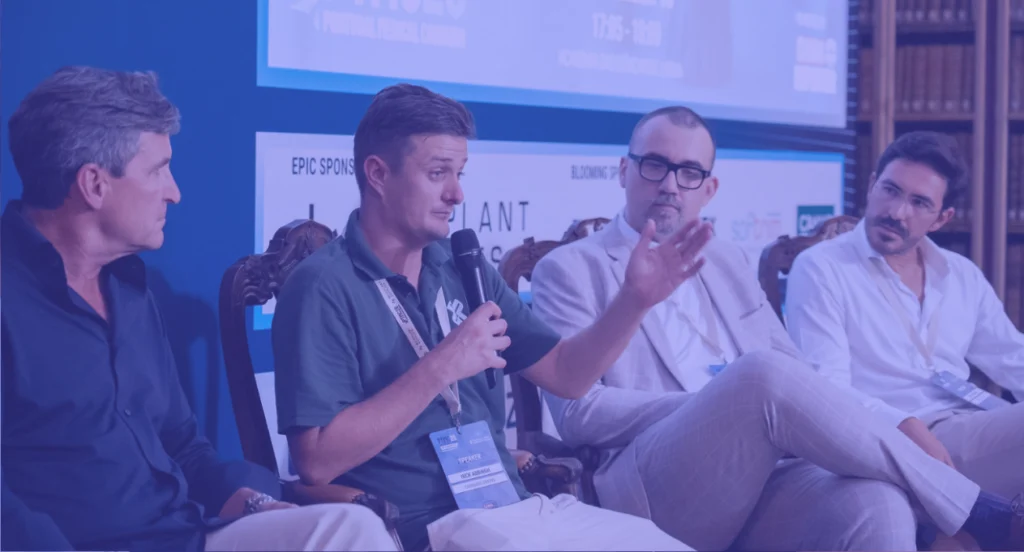
Insights extracted from a focus group discussion at PTMC – Portugal Medical Cannabis on September 10, 2026. Panellists: Bastiaan Nierop (Kannapack Holland BV), Arthur de Cordova (Ziel), Nick Abbingh (Cannabis-Drying.com), Dr Michal Wojcicki (Pharmaserv AG) and José Tempero (Tilray Medical). Moderated by Margarita Cardoso de Meneses (PTMC).
After the Plant Is Cut
In a focus group titled “Preserving Cannabis Quality: Maximising Value Through Post-Harvest Processes” unter PTMC (Portugal Medical Cannabis) 2026, the final session of the day, moderator Margarita Cardoso de Meneses set the scene simply: after the plant is cut, many things can happen. Margarita, who is an author, journalist and contributor to CannaReporter, steered the group away from a standard question-and-answer format and into a genuine debate between the people who handle cannabis between harvest and the pharmacy shelf.
The panel covered almost every step of that journey. Nick Abbingh von Cannabis-Drying.com builds tray and hang drying systems for EU-GMP facilities. Arthur de Cordova von Ziel runs a radiofrequency microbial reduction technology that grew out of food pasteurisation. Bastiaan Nierop von Kannapack makes semi-automatic packaging machines. Dr Michal Wojcicki of Swiss EU-GMP processor Pharmaserv AG sits between producers and wholesalers, and José Tempero von Tilray Medizinisch brought the medical and patient perspective.

The timing could hardly have been sharper. Three months earlier, the German state of Hesse had issued guidance treating drying as a critical GMP manufacturing step that should, in principle, happen at the harvest site, a move widely reported as a direct challenge to “GMP washing” in imported flower. It reopened a debate that an earlier PTMC 2026 panel on EU-GMP had already tackled from the regulatory side: where exactly does GACP end and EU-GMP begin? Lumino’s own guide to cannabis quality assurance places drying on the GACP side of that line. Germany’s largest import market is now pushing it firmly onto the GMP side, and the people in this room are the ones who have to make either answer work in practice.
The Numbers Behind the Focus Group
The post-harvest specialists brought hard numbers to a debate that is usually argued on principle:
- Nick said tray drying can hold up to 20 kilograms of dried flower per square metre, against roughly two to four kilograms with hang drying, a major saving in cleanroom space where every square metre is expensive. His systems push air through HEPA filters above and below the trays, creating what he called “a clean room within a clean room”, and dry to a uniform moisture content of around 10 to 12%.
- To preserve Terpene, Nick recommended drying at lower temperatures of around 16 to 18°C. He suggested freeze-drying only for material going to extraction, since it leaves most of the chlorophyll in the flower and gives smokeable product a grassy taste.
- Arthur put losses on untreated product anywhere between 1% and 25% of a batch. On a simple example of 1,000 kilograms selling at €1,000 per kilo, a 20% failure wipes out €200,000 in revenue, and even a 10% failure rate, he argued, can be the difference between profitability and bankruptcy. Ziel’s radiofrequency process received EU-GMP certification for cannabis in 2024.
- Germany’s state of Hesse issued its guidance on 8 June 2026, treating controlled drying as a critical manufacturing step with critical process parameters, and expecting GMP drying and trimming to take place where the plants are harvested unless a company can prove otherwise. Dr Michal reported that inspectors in other German states have already started applying it.
- Microbial limits still vary sharply across Europe. Dr Michal described Poland as the strictest market, where flower effectively has to be irradiated to be registered, with Germany the most lenient and the UK somewhere in between.
The Post-Harvest Sequence, Step by Step
Between them, Nick and Arthur laid out the order of operations most EU-GMP facilities now follow after the plant is cut:
- Harvest and buck: plants are cut and the flowers stripped from the stems (bucking). For tray drying, bucking comes before drying.
- Dry: on trays or hanging, at around 16 to 18°C, down to a moisture content of roughly 10 to 12%.
- Dry trim: Nick recommends trimming after drying, since wet trimming “tends to be a little bit of a mess”.
- Cure: the flower is cured before any microbial treatment.
- Microbial treatment: the “kill step”, whether radiofrequency or irradiation, is the last stage before testing.
- Test and package: release testing, then weighing and packing for the pharmacy or market.
How Producers Are Responding to Germany's Drying Rule
The panel described three ways producers are adapting to Hesse’s guidance, each with its own trade-off:
- Dry under GMP at the harvest site: the most direct route, but it means building a GMP drying room at the farm itself.
- Buy wet flower locally and dry it yourself: Arthur described a large Canadian exporter buying up all the wet flower it can within an eight-hour drive of its premises, then drying it on site under GMP. The approach has limits. Nick described a South African client trucking wet flower for ten hours, which he said adds cost without improving anything, and Dr Michal warned that wet flower shipped for a day or two can simply be thrown away.
- Split the drying: some producers pre-dry to around 18 to 20% moisture under GACP, then finish in a GMP drying room. Nick questioned the logic, since it means building two sets of drying rooms when a GMP drying room only needs a little more dehumidification capacity to do the whole job.
There is also an early precedent for flexibility. Dr Michal said a German inspector told one of his clients they would accept flower from a nearby Swiss GACP grower, dried and processed under GMP at Pharmaserv, provided the transport took only one to two hours under GDP and the product was retested three times to prove the process works.
5 wichtige Erkenntnisse

- Nobody agrees on where GMP starts, and the regulators are filling the gap. Asked from the floor whether drying has to happen under GMP, the panel gave several honest and conflicting answers: GMP starts at the cut, when the flower leaves the greenhouse, when it is dry, or partway through drying. As one audience member put it, if the industry cannot agree on a common view, it cannot expect regulators to share one either.
- Germany’s drying rule is reshaping supply chains in real time. Dr Michal argued that if flower meets the European Pharmacopoeia requirements, where it was dried should not matter, pointing out that herbal medicines like mint are routinely dried abroad. Nick agreed on compliance, but added that consistent GMP post-harvest processing makes the same cultivar far more likely to taste and perform the same a year later. Either way, producers are already adapting, from drying at the harvest site to buying in wet flower from nearby growers.
- Microbial control is a business continuity issue, not just a compliance box. Arthur’s case was financial: a single failed harvest can mean lost revenue, retesting costs, missed contracts, a mark against you with the regulator and, in the worst case, a recall that damages the brand. Most operators, he said, now treat the kill step as standard rather than waiting for a batch to fail. Good drying helps too: a lower microbial load coming out of the drying room can keep a borderline batch under the limit and sold at full price.
- Buyers now judge post-harvest equipment on lifetime cost, not price tag. Arthur described a shift from “I’ll only pay this” towards questions about total cost of ownership and what he calls the levelised cost of processing. Nick added that the clients doing well are increasingly the ones arriving from pharma, rather than from the legacy market or general entrepreneurship.
- Quality has two layers, and only one is written in the SOPs. José separated regulatory quality, the specifications a QA team signs off, from experiential quality, how the product actually performs for the patient. Both drive the price a product can command, but only the first is usually captured in a facility’s working instructions.
Notable Quotes from the Focus Group
"You guys are the specialists in post-harvest. You know what the issues are in your specific area. After the plant is cut, many things can happen, and that's what we want to know."
Margarita Cardoso de Meneses, PTMC (moderator)
"In the CBD market, they want the machine to run fast and they have a low budget. But in the Dutch experiment, there is budget. They want a solid system with all options and a good print."
Bastiaan Nierop, Co-Founder, Kannapack Holland BV
"You don't want to sell little buds in the coffeeshop, because they want a big bud. So we reserve two buckets for bigger buds, and then you combine them with the rest."
Bastiaan Nierop, Co-Founder, Kannapack Holland BV

"It's not heavy metals or pesticides that keep operators up at night, it's microbials. They're there, they're pesky, and they're going to show up wherever."
Arthur de Cordova, President & CEO, Ziel
"There's a lot of money in post-harvest equipment that is often overlooked at the beginning. People think about their lights. Well, post-harvest is where the real magic happens, or where it completely fails and goes sideways in a second."
Arthur de Cordova, President & CEO, Ziel
"If the whole post-harvest process is done according to GMP, the chance of that cultivar being the same as it was one and a half years ago is larger. But I do agree, if it meets the standards, it meets the standards. It is a medicine."
Nick Abbingh, Managing Partner, Cannabis-Drying.com
"The ones of you that have been building clean rooms will know the price of a square metre. It's not really happy days, unless you're the guys selling the clean rooms. But if you can save on that, you can save a lot on your initial investment."
Nick Abbingh, Managing Partner, Cannabis-Drying.com
"We all use medicines based on herbal materials. Do you really think leaves like mint are dried under GMP before they are sent from Asia to European companies? I don't know why cannabis is something special in this regard."
Dr Michal Wojcicki, Chief Sales Officer, Pharmaserv AG
"The biggest problem that we face right now, and not only us but all GMP processors, is the constantly changing laws and regulations in different countries. Sometimes they change from one day to another, without any official statement."
Dr Michal Wojcicki, Chief Sales Officer, Pharmaserv AG

"There are two layers of quality. One is regulatory, another one is the experience of the patient, and the person who handles one within a facility is not exactly the one who deals with the second."
José Tempero, Tilray Medical
"The patient is not aware of the GMP details of a paracetamol pill, or the GDP rules every medicine has to follow through its supply chain. And they shouldn't be. They should be aware that there are safeguards, and that everything is in place."
José Tempero, Tilray Medical
Referenzen
- Lumino: “Stoppt die Bezeichnung ”GMP-Waschen! Eine Diskussion von PTMC 2026““
- Lumino, “Cannabis Quality Assurance: EU-GMP, GACP and Laboratory Testing”
- Business of Cannabis, “‘No Right to GMP Washing’: German State Challenges Cannabis Flower Import Compliance”
- GlobeNewswire, “Ziel Microbial Control Solution for Cannabis Receives EU GMP Certification”




 English (UK)
 Deutsch