
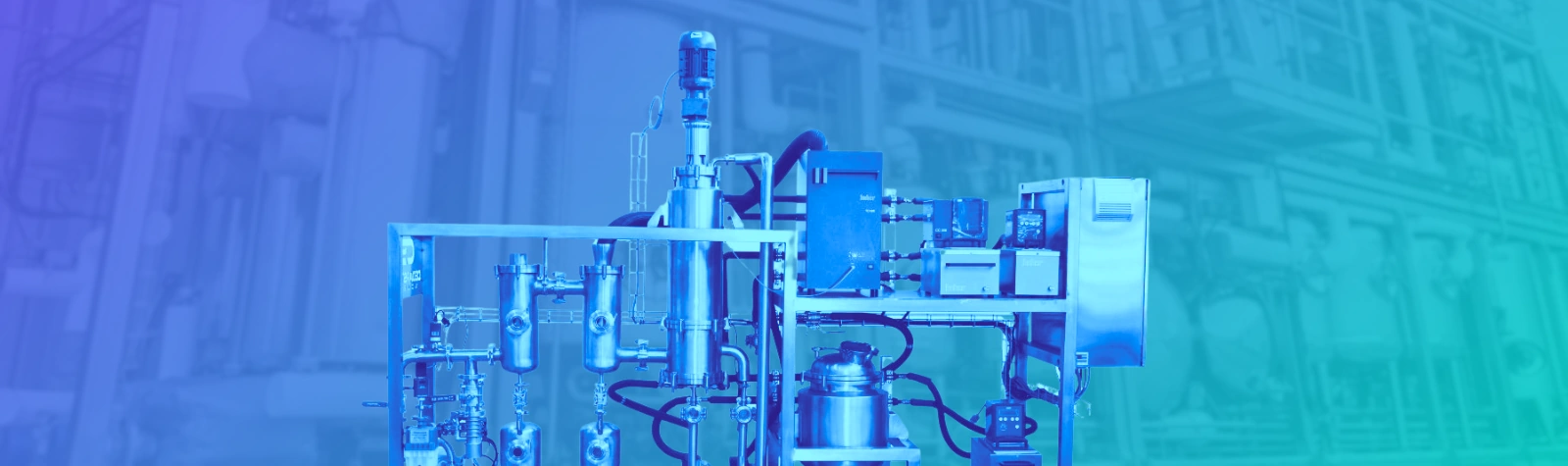
Everything on a European medical cannabis shelf that is not raw flower had to be extracted from flower first.
Extraction is the step that turns dried buds into oils, sprays, capsules and topicals. It uses either a solvent (CO2, ethanol or a hydrocarbon like butane) or no solvent at all (ice water hash, rosin), followed by refinement steps like winterisation, decarboxylation and distillation. What comes out the other end is a full-spectrum, broad-spectrum, distillate or isolate product, each with a different chemistry, use case and regulatory profile.
If cultivation is the first half of the cannabis industry, extraction is the second. It is the point at which a plant becomes a pharmaceutical input: concentrated, purified, standardised, and, if it is being made for a European pharmacy, produced under EU-GMP conditions in facilities that look a lot more like a lab than a farm.
For a professional stepping into the sector, extraction is often the least visible part of the process. Nobody photographs a wiped-film distillation column the way they photograph a mature flowering plant. But it is where a lot of the commercial and scientific action lives, and it is worth understanding the vocabulary if you are working anywhere near medical cannabis products.
This is the seventh article in our Cannabis 101 series. In the previous article we covered the five main product formats and the four consumption routes that reach the patient. Here we take a step upstream and look at how those oils, capsules, sprays and topicals are actually made, from the moment cured flower enters an extraction facility to the moment a finished extract is ready for formulation.
Why extract at all?
Dried flower is already a finished medical product in most European markets. So why bother turning it into an extract?
Three practical reasons drive the entire extraction industry:
🟣 Concentration. A well-cured cannabis flower typically contains between 15% and 25% cannabinoids by dry weight. An extract can concentrate those cannabinoids into a substance that is 70% to over 90% cannabinoids by weight, with the highest-purity distillates and isolates reaching upwards of 90–99%. That means smaller doses, smaller packaging and much longer shelf life per gram of medicine.
🟣 Precision. Once cannabinoids are in a liquid or crystalline form, they can be measured, blended and dosed with pharmaceutical accuracy. A drop of 10 mg/ml THC oil is the same drop every time; a puff of dried flower is not. That precision is what makes oils, capsules and sprays possible.
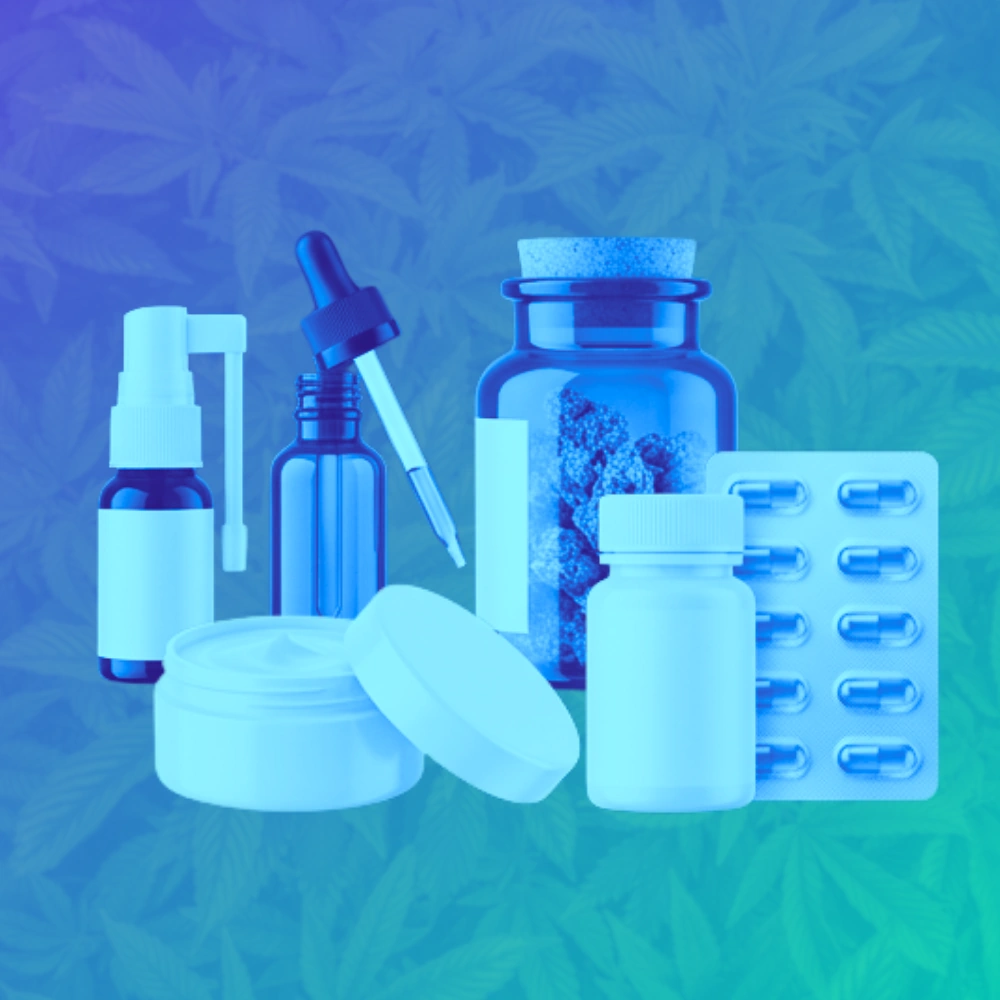
🟣 Product variety. Almost every non-flower format we covered in Article 6 exists because someone extracted the plant first. Without extraction, there would be no Sativex spray, no CBD tincture, no cannabis topical, no capsule. Extraction is the enabling step that turns cannabis into a family of products rather than a single one.
Every extraction method, whether it uses a chemical solvent or none at all, is really doing the same job: pulling the cannabinoid- and terpene-rich resin out of the plant material and leaving the fibrous, mostly-inert plant tissue behind. What differs is how that separation is done, and each method leaves its own fingerprint on the finished extract.
🌱 Fun fact:
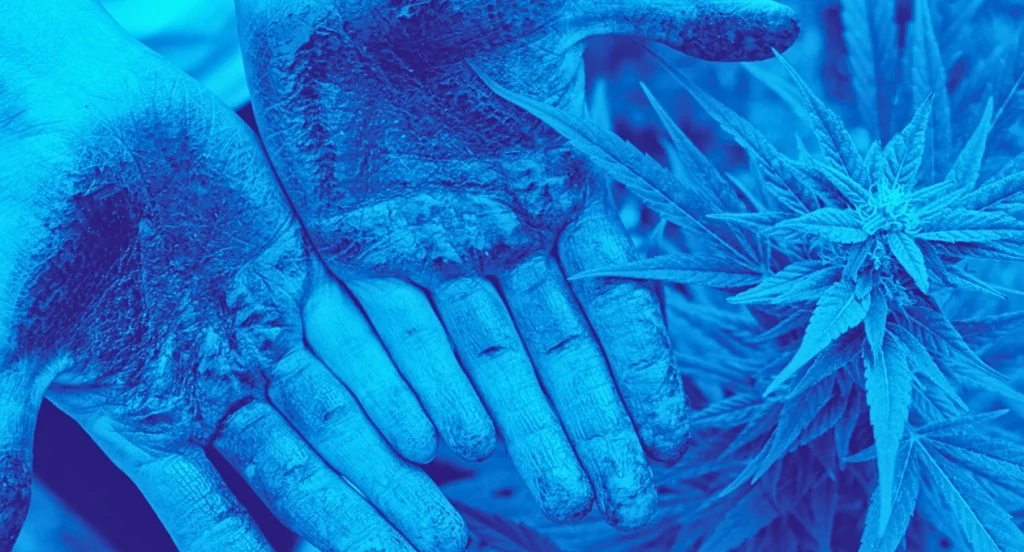
The oldest form of cannabis extraction is thousands of years old and requires no equipment at all. Hand-rubbed charas, still produced traditionally in parts of India and Nepal, is made by rubbing fresh cannabis flowers between the palms so trichomes stick to the skin, then scraping the accumulated resin off. It is the direct ancestor of every modern solventless technique used in high-end European extraction facilities today.
Solvent-based methods
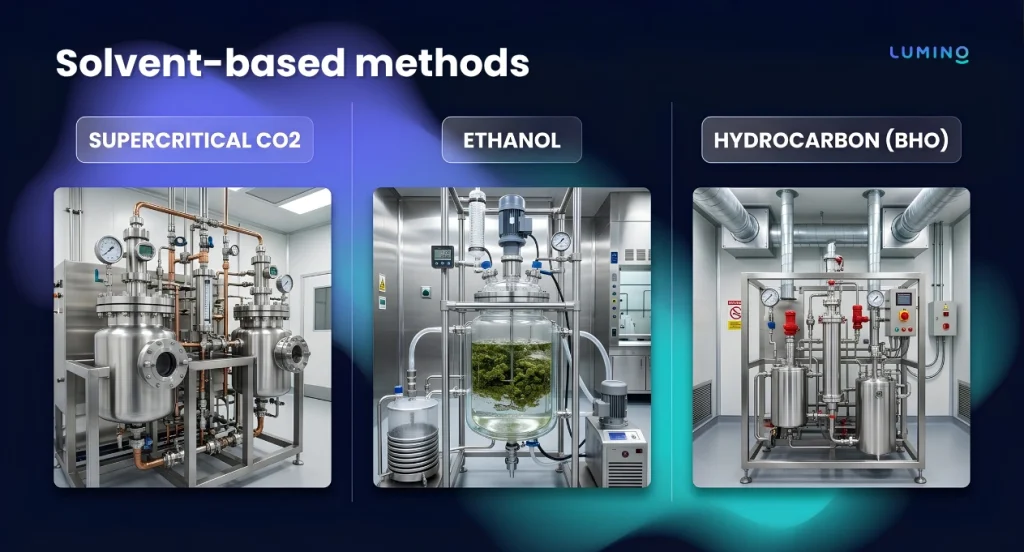
The majority of medical cannabis extract on European pharmacy shelves is made using a solvent: a chemical that dissolves cannabinoids and terpenes out of the plant material, and is then evaporated or otherwise removed at the end of the process. There are three dominant solvents in commercial use.
🟣 Supercritical CO2 extraction
Carbon dioxide becomes a supercritical fluid above 31.1°C and 1,071 psi (about 74 bar), a state where it behaves simultaneously like a gas (diffusing freely through ground plant material) and a liquid (dissolving cannabinoids and terpenes as a proper solvent). Extractors pump supercritical CO2 through a vessel packed with dried cannabis, then release it into a separator where a drop in pressure causes the extracted compounds to fall out of solution as an oil. Typical commercial parameters sit around 55°C and 235–340 bar depending on the target cannabinoid profile, and yields can reach up to 8–19% by weight at the higher end of the pressure range.
CO2’s advantages are safety and cleanliness: it is non-toxic, non-flammable, and leaves no residual solvent in the finished extract, which is a major reason it is one of the two dominant methods in EU-GMP facilities. Its downsides are capital cost (a supercritical rig can run into the hundreds of thousands of euros) and slower throughput compared to ethanol.
🟣 Ethanol extraction
Ethanol is the most common solvent used at commercial scale worldwide, largely because it is cheap, widely available and non-toxic. It is used in two variants:
🟣 Cold (cryogenic) ethanol runs at sub-zero temperatures, typically around –40°C. At that temperature, ethanol preferentially dissolves cannabinoids and terpenes while leaving behind most of the chlorophyll, waxes and lipids, producing a cleaner extract that needs less refinement.
🟣 Warm ethanol runs at room temperature or up to 40–50°C. It extracts faster and captures a broader range of compounds, but also pulls out chlorophyll and waxes that must be removed later through a step called winterisation (covered below).
Ethanol is the workhorse of scaled European medical extraction, and it is the method used in a documented process to produce GMP-grade full-extract cannabis oil, where deep-cooled ethanol extraction is paired with wiped-film distillation for final purification.
🟣 Hydrocarbon (butane / propane) extraction
Butane and propane, individually or in a blend often called BHO (butane hash oil), have very low boiling points, which lets extractors preserve delicate terpenes and produce concentrates that are unusually aromatic. They are widely used in the North American adult-use market for premium concentrates like shatter, wax and live resin.
The trade-off is serious safety risk. Butane is highly flammable, heavier than air (which means it pools in low areas and enclosed spaces), and has caused numerous documented lab explosions worldwide. Commercial operators are required to use closed-loop systems that recycle the solvent rather than release it, and residual solvent testing is a mandatory step in every batch. In the European medical context hydrocarbon extraction is rare, both because of the safety burden and because CO2 and ethanol already meet the needs of most EU-GMP producers.
🌱 Fun fact:
The supercritical state used in CO2 extraction is not unique to cannabis. The exact same technology is used commercially to decaffeinate coffee, extract hop oils for beer and produce flavour concentrates for the food industry. Cannabis extractors did not invent the technology; they inherited it from decades of food-science engineering.
Solventless methods
Not every extract uses a chemical solvent. A parallel family of techniques, collectively called solventless extraction, uses only physical forces (agitation, cold, heat and pressure) to separate the resinous trichomes we covered in Article 2 from the rest of the plant. Solventless methods are increasingly prized in the European premium market because they produce extracts with no residual solvent whatsoever and unusually rich terpene profiles.
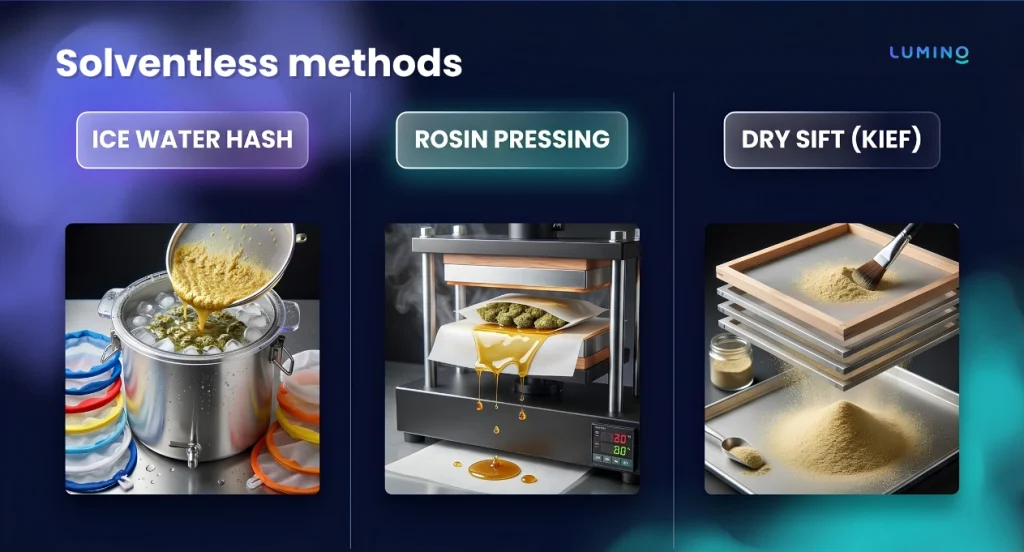
🟣 Ice water hash (bubble hash)
Fresh-frozen or dried cannabis flower is submerged in a vessel of ice water and gently agitated. The cold makes the trichome heads brittle enough to snap off, and the agitation shakes them loose from the plant material. Because trichome heads are denser than water and the plant matter is not, the freed trichomes sink through a series of stacked mesh bubble bags (typically ranging from around 220 to 25 microns) while the plant material floats. The collected trichome material is called bubble hash or ice water hash, and once dried it can be smoked, vaporised, or pressed further into rosin.
The process is entirely mechanical: the only inputs are water, ice, cannabis and time, with no chemistry to purge out at the end.
🟣 Rosin pressing
Rosin is made by pressing cannabis flower, kief or bubble hash between two heated plates at controlled temperature and pressure. Typical parameters sit around 80–105°C (roughly 180–220°F) and 500–2,000 psi for 30–90 seconds per press. The heat softens the trichome resin and the pressure squeezes it out through a filter bag onto parchment paper, leaving the fibrous plant material behind as a flat, spent puck.
Rosin made from bubble hash rather than flower directly is called hash rosin, and rosin made from fresh-frozen cannabis (rather than dried and cured) is called live rosin. Live rosin is currently the most sought-after solventless concentrate in premium markets, routinely reaching 60–80% THC while preserving a much fuller terpene profile than most solvent-based concentrates.
🟣 Dry sift (kief)
The simplest solventless method of all. Dried cannabis is gently agitated over a series of fine mesh screens; the trichome heads break off and fall through, leaving a fine tan-coloured powder called kief or dry sift. It has been used for centuries in traditional hashish production across North Africa, the Middle East and Central Asia, and it is still the input for most traditionally-made hash and a common material for pressing into rosin.
All three solventless methods share the same commercial trade-off: lower yield per gram of biomass than solvent-based methods, in exchange for higher purity, better terpene preservation and a much simpler regulatory story. For premium European producers, that trade-off is increasingly worth making.
🌱 Fun fact:
Traditional hashish production in parts of Morocco and Afghanistan uses essentially the same dry-sift technique that a modern boutique European rosin operation uses today, just with woven cloth instead of stainless-steel micron screens. The technology has barely changed in centuries; only the labels have.
Refinement: what happens after the extract comes out
Whichever method is used, what comes out of an extraction machine is almost never a finished medical product. It is a crude extract, a thick amber or dark green oil containing not just cannabinoids and terpenes but also lipids, waxes, chlorophyll, plant fibres and (in solvent-based methods) trace residual solvent. Turning that crude into something a European pharmacy can dispense takes several refinement steps.
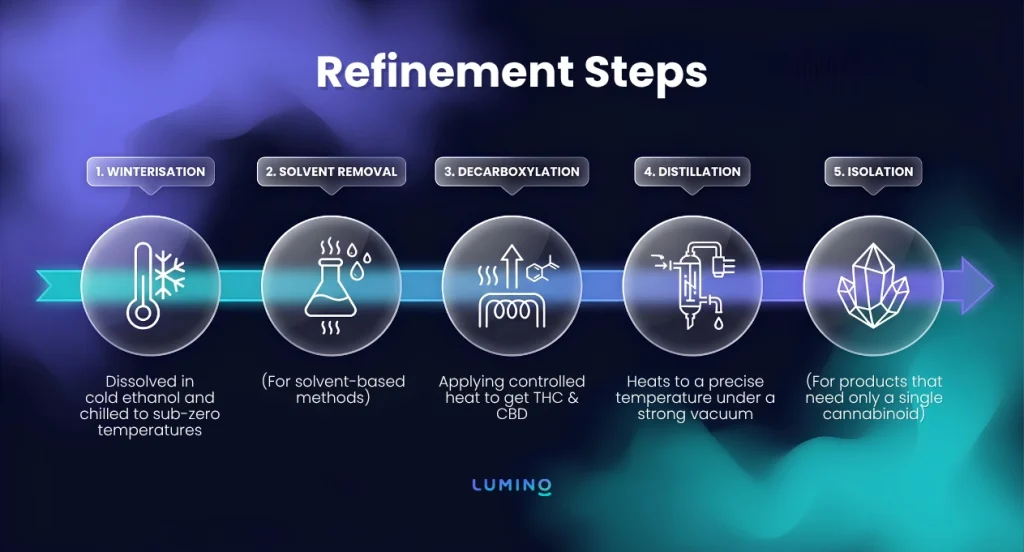
🟣 Winterisation
The crude extract is dissolved in cold ethanol and chilled to sub-zero temperatures, typically around –40°C for 24–48 hours. At those temperatures, fats, waxes and lipids fall out of solution as solids and can be filtered out, leaving a cleaner, clearer cannabinoid-rich liquid behind. Winterisation is standard for warm-ethanol extracts and often used after CO2 extraction too. Cold-ethanol extracts frequently skip this step because the extraction itself already excludes most waxes.
🟣 Solvent removal
For solvent-based methods, the ethanol or CO2 has to be removed from the extract before anything else happens. In ethanol workflows this is done using a rotary evaporator or a falling-film evaporator, which gently boils off the ethanol under vacuum at low temperature so the cannabinoids and terpenes are not degraded by heat. In CO2 workflows, the solvent is simply released as it exits the extraction vessel (CO2 returns to gas at normal atmospheric pressure).
🟣 Decarboxylation
As we covered in Article 3, raw cannabis produces cannabinoids in their acidic forms (THCA and CBDA), which are not psychoactive and are not what most medical products are dosed on. Decarboxylation is the controlled application of heat that removes a carboxyl group from those acidic precursors and converts them into their active forms (THC and CBD). It is essential before distillation to prevent the extract from frothing under vacuum, and it is where the extract’s cannabinoid potency figures on a certificate of analysis actually come from.
🟣 Distillation
The decarboxylated extract is then run through short-path or wiped-film distillation, which heats it to a precise temperature under a strong vacuum (typically well below atmospheric pressure, as low as 0.2 mbar in GMP-grade processes) so that individual cannabinoids and terpenes vaporise and are captured separately from each other and from remaining plant compounds. What emerges is a translucent, honey-like liquid called cannabis distillate, typically 90% or more cannabinoids by weight.
🟣 Isolation (optional)
For products that need only a single cannabinoid, distillate can be further refined through crystallisation or chromatography to produce a cannabinoid isolate: a white crystalline powder that is typically 98–99% pure CBD (or another specific cannabinoid). This is the material used in products where no THC can be present, and it is the starting point for many high-precision pharmaceutical formulations.
Every one of these steps is documented, temperature-logged, sampled and tested inside an EU-GMP facility. What comes out at the end is not just a chemical: it is a batch, with a lot number, a certificate of analysis and a paper trail that will follow it through formulation, packaging and eventually into a pharmacy.
🌱 Fun fact:
The distillation equipment used in modern cannabis facilities was not invented for cannabis at all. Wiped-film and short-path distillation systems were originally developed for industries handling heat-sensitive or high-molecular-weight compounds, from pharmaceuticals and vitamins to fragrances and specialty chemicals, where boiling something at atmospheric pressure would destroy it. Cannabis is one of the newest markets to adopt technology the food and pharma industries have used quietly for decades.
Full-spectrum, broad-spectrum, distillate and isolate
At the end of the extraction and refinement process, every cannabis extract sits somewhere on a spectrum of “how much of the original plant did we keep?” There are four categories worth knowing, because they appear on almost every European product label and marketing document.
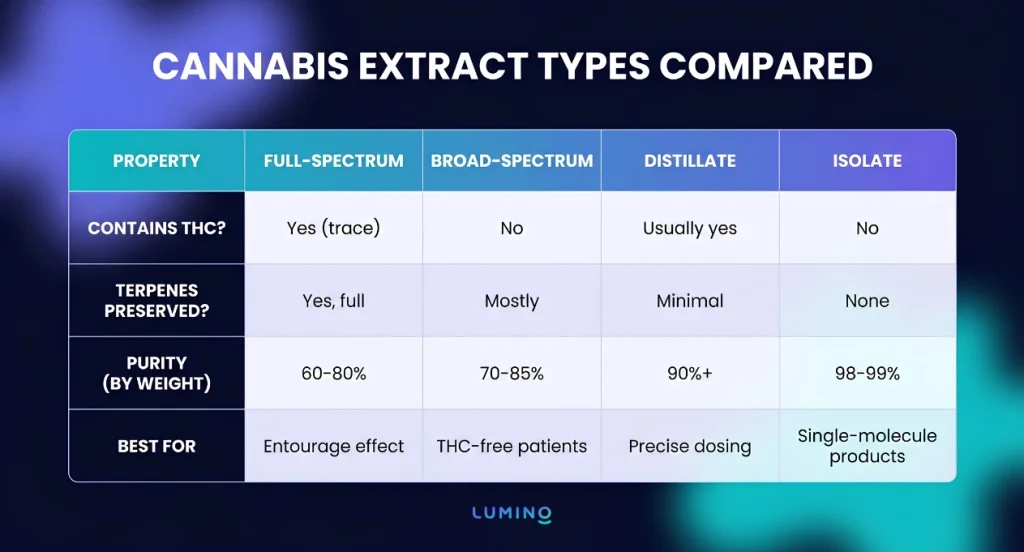
🟣 Full-spectrum extract
Contains the full profile of cannabinoids, terpenes and other phytochemicals originally present in the plant, including legally permitted trace THC. It undergoes the lightest processing of the four categories, typically winterisation and decarboxylation but not full distillation, and it is the extract type most closely associated with the entourage effect we covered in Article 3.
🟣 Broad-spectrum extract
Keeps most of the cannabinoids and terpenes but has had the THC selectively removed, either by distilling it out of a full-spectrum extract or by adding minor cannabinoids and terpenes back into CBD isolate. It is the go-to format for patients or markets that want a fuller phytochemical profile without any THC exposure.
🟣 Distillate
A highly refined single-solvent-free liquid, typically 90% or more cannabinoids by weight, produced by short-path or wiped-film distillation. It retains a small amount of secondary compounds but has lost most of the volatile terpenes during the distillation process. Distillate is the workhorse of most oil, capsule and vape formulations because it is pure enough to dose precisely and stable enough to formulate consistently.
🟣 Isolate
A single cannabinoid (usually CBD, sometimes CBG or CBN) refined to 98–99% purity and presented as a white crystalline powder. It contains no other cannabinoids, no terpenes and no plant compounds, and it is the most precise starting material for products that need to guarantee the complete absence of THC or any other minor cannabinoid.
The four categories are not ranked from “worse” to “better”. Each one earns its place for a different clinical or commercial reason:
🟣 A pain patient prescribed a full-spectrum oil is being given the terpene and minor-cannabinoid profile the plant produced, on the theory that the entourage effect adds meaningful value.
🟣 A workplace-drug-tested patient prescribed a broad-spectrum tincture is being protected from THC exposure while still getting most of the plant’s other compounds.
🟣 A patient on a precisely-titrated distillate capsule is being given consistent, reproducible dosing crop after crop, batch after batch.
🟣 A patient prescribed a CBD isolate for rare treatment-resistant childhood epilepsy, as in the case of Epidyolex, is being given a fully-characterised single-molecule pharmaceutical with no other cannabinoids at all.
This is why the same cannabis flower can leave one extraction facility as four completely different regulated products, each aimed at a different patient, prescriber and market.
🌱 Fun fact:
Cannabis is one of very few plants where all four of these extract categories exist as commercially viable products at the same time. Coffee, for comparison, is sold mostly as one thing (whole bean or ground) with a handful of variations. Cannabis’s four-tier extract landscape is a direct consequence of its unusually wide chemical variety and multi-cannabinoid pharmacology, and it is one of the reasons European medical formulation is such a fast-growing corner of the industry.
Why extraction matters to jobs in the European cannabis industry
Extraction is one of the most technically-loaded corners of the medical cannabis industry, and it maps onto a whole cluster of specialised European jobs that did not really exist a decade ago:
🟣 Extraction technicians and process engineers run the machines. Supercritical CO2 rigs, cold-ethanol systems, closed-loop hydrocarbon units and rosin presses all require operators who understand not just how to push the buttons, but how temperature, pressure, time and biomass quality interact to shape the finished extract.
🟣 Quality control and analytical chemistry teams live in the extraction facility’s testing lab. They characterise every batch of crude, distillate and isolate against a specification, catch residual solvent, chlorophyll or wax problems early, and produce the certificates of analysis that follow each batch downstream.
🟣 Formulators and product developers take purified extracts and turn them into the oils, capsules, sprays and topicals we covered in Article 6. A formulator needs to know exactly what kind of extract they are working with (full-spectrum, broad-spectrum, distillate or isolate) because it changes everything about dosing, solubility, shelf life and regulatory status.
🟣 Compliance and QA professionals shepherd extraction operations through EU-GMP certification and audits. Extraction sits under EU-GMP rather than GACP (which stops at drying), so the paperwork, validation protocols and cleanroom requirements are stricter here than anywhere else in the supply chain.
🟣 Facility engineers design and maintain the specialised environments extraction demands: solvent-safe rooms with explosion-proof electrics for ethanol and hydrocarbon operations, high-pressure infrastructure for supercritical CO2, hygienic cleanrooms for post-processing, and cold-storage areas for winterisation.
🟣 Business and commercial leaders in medical cannabis producers use extraction capability as a strategic differentiator. A company with in-house EU-GMP extraction is a fundamentally different competitor from one that imports finished extract, and that choice shapes everything from margins to product roadmap to acquisition value.
Extraction is where cannabis stops being agriculture and starts being pharmacology. If cultivation is the discipline that produces the raw material of medical cannabis, extraction is the discipline that turns that raw material into medicine. It is one of the most European-heavy corners of the global industry today, precisely because EU-GMP has raised the bar so high that only serious operators can play at scale.
In the final article in our Cannabis 101 series we close the loop and look at the quality systems, EU-GMP, GACP and laboratory testing, that make sure everything we have described across the previous seven articles actually ends up as a safe, consistent, patient-ready medicine on a European pharmacy shelf.
Frequently asked questions
What is cannabis extraction?
Cannabis extraction is the process of separating cannabinoids, terpenes and other active plant compounds from the fibrous plant material of dried and cured cannabis flower. It uses either a chemical solvent (CO2, ethanol or a hydrocarbon like butane) or purely physical means (heat, pressure, ice water, agitation) to pull the resin out of the plant. The resulting extract is then refined into oils, distillates, isolates and finished medical products.
What is the difference between solvent-based and solventless extraction?
Solvent-based methods (CO2, ethanol, butane) use a chemical to dissolve cannabinoids and terpenes out of the plant, then evaporate the solvent away. They are the workhorses of large-scale European medical extraction. Solventless methods (ice water hash, rosin, dry sift) use only physical forces to separate trichomes from plant material, produce extracts with no residual solvent, and preserve terpenes especially well, but at the cost of lower yield per gram of biomass.
Which cannabis extraction method is "best"?
There is no single best method. Supercritical CO2 is preferred for clean, safe, EU-GMP-compliant extract with no residual solvent. Ethanol is the workhorse of scaled commercial extraction because it is cheap, non-toxic and widely available. Hydrocarbon methods produce terpene-rich premium concentrates but carry serious safety risks. Solventless methods produce the purest premium concentrates but yield less product per gram of input. The right choice depends on the target product, budget, regulatory environment and safety infrastructure.
What is winterisation, decarboxylation and distillation?
Three post-extraction refinement steps. Winterisation chills the extract dissolved in ethanol to sub-zero temperatures to precipitate and filter out fats, waxes and lipids. Decarboxylation heats the extract to convert acidic cannabinoids (THCA, CBDA) into their active forms (THC, CBD). Distillation uses heat under vacuum to separate individual cannabinoids and terpenes, producing a translucent liquid typically 90%+ pure by weight.
What is the difference between full-spectrum, broad-spectrum, distillate and isolate?
Full-spectrum keeps the full profile of cannabinoids and terpenes, including trace THC. Broad-spectrum keeps most compounds but has had THC removed. Distillate is a highly-refined 90%+ single-cannabinoid liquid that has lost most terpenes during processing. Isolate is a 98–99% pure single-cannabinoid crystalline powder with no other plant compounds at all. Each earns its place for a different clinical or commercial reason.
References
- Effective CO2 extraction: supercritical vs subcritical (Cannabis Tech)
- Fundamentals of supercritical fluid extraction: CO2 for cannabis (Cannabis Science and Technology)
- Valorization of wild-type Cannabis indica by supercritical CO2 extraction (PMC)
- The pros and cons of cannabis ethanol extraction (Technology Networks)
- Cold ethanol extraction: effective techniques, benefits & uses (Root Sciences)
- The cold standard: how low-temperature ethanol extraction preserves cannabinoids and terpenes (Western States)
- Process development for GMP-grade full-extract cannabis oil (PMC, 2024)
- Hydrocarbon vs CO2 vs ethanol extraction (The Original Resinator)
- Safety concerns in BHO production (USA Lab)
- Risks in the cannabis industry: BHO lab explosions (BakerRisk)
- What does solventless mean for cannabis extracts? (Low Temp Plates)
- Introduction to solventless hash rosin (Low Temp Plates)
- Solventless cannabis extraction methods explained (Root Sciences)
- Using the rosin press for pure, solventless cannabis extraction (USA Lab)
- Solventless extraction: a guide to ice water extraction (Catalyst BC)
- Cannabis extracts explained: distillate vs isolate vs full-spectrum (Hempire Gardens)
- Full spectrum, broad spectrum and isolate CBD: what’s the difference? (SōRSE Technologies)
- Your complete guide to EU GMP-certified CBD isolate and distillate (Cannadelics)
- Epidyolex — European Medicines Agency EPAR (EMA)
- Cannabis plant anatomy: a field guide from roots to trichomes (Lumino, Cannabis 101, Article 2)
- THC, CBD and terpenes: the chemistry behind cannabis (Lumino, Cannabis 101, Article 3)
- Medical cannabis products: from flower to oil, vaporiser to tincture (Lumino, Cannabis 101, Article 6)

 English (UK)
 Deutsch