
Cannabis is one of the oldest plants humans have ever cultivated.
The earliest archaeological traces of it date back roughly 10,000 years to Neolithic Japan, and it has been treated as medicine in China, Egypt, India and eventually Europe ever since. A short, harsh century of prohibition interrupted that continuity. The plant is only now quietly returning to European pharmacies, and understanding how it got here is the fastest way to make sense of the industry building around it today.
Long before it became a political argument, cannabis was a tool. It made rope for sailors, cloth for peasants, paper for scholars, oil for lamps and medicine for almost everyone. The earliest hard evidence we have of the plant in human hands comes from the Torihama Shell Mound in Japan, where archaeologists dated cannabis seeds and rope fragments to around 10,000 BCE. By the time cannabis reached Europe, it was already an ancient companion of humanity, well travelled across the trade routes of Asia alongside silk, spice and grain.
Rediscovering that story is not a nostalgic exercise. It is the fastest way to understand why cannabis has such an unusual relationship with modern medicine, why an entire industry vanished in the twentieth century, and why the doors are opening again now, most visibly in Europe. A pharmacist writing a prescription in Berlin, a compliance lead auditing a Portuguese cultivator, a founder pitching in London, all of them are standing on 10,000 years of context. Once you can see it, a lot of today’s headlines start to make sense.
This is the first article in our Cannabis 101 series, a plain-English guide for professionals stepping into the sector. We are not here to romanticise the plant or to campaign for it. We are here to give you the historical map you need to make sense of the market you are about to work in.
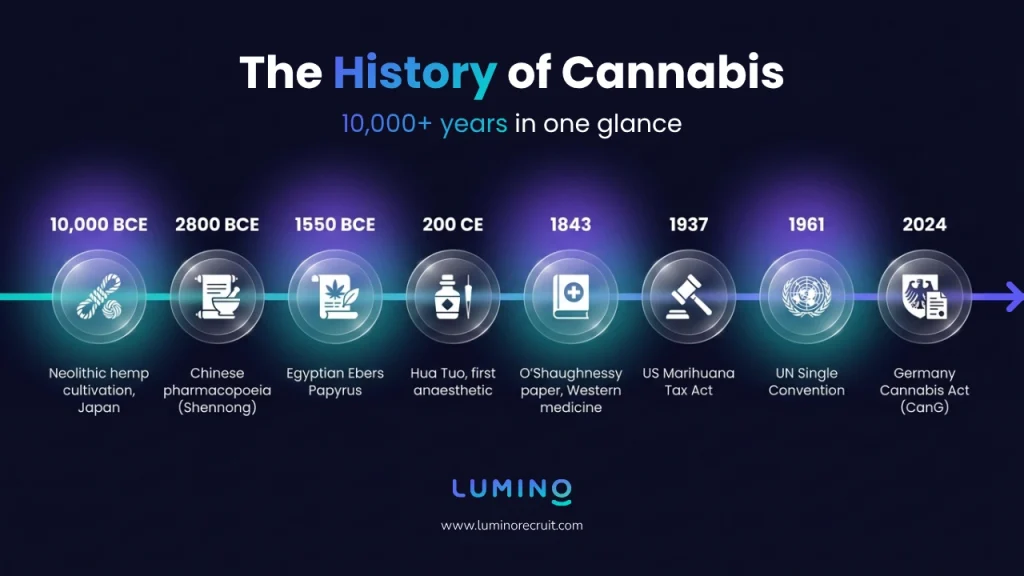
One of the oldest cultivated plants
The cannabis plant is thought to originate in Central Asia, most likely on the steppes and foothills north of the Himalayas. From there it spread outward through human hands rather than by any accident of climate. Wherever people went, they carried it.
The earliest hard evidence comes from the Torihama Shell Mound in Japan’s Fukui Prefecture, where archaeologists have dated cannabis seeds and rope fragments to roughly 10,000 BCE. Similar Neolithic finds have turned up on the Tateyama site in Chiba, and archaeobotanical analysis suggests the plant was already being cultivated for its hemp fibres long before anyone worked out what its resin could do. The earliest uses were, quite literally, mundane: rope, netting, textiles, and later paper.
💡A quick note: is hemp the same as cannabis?
Yes – and no. Botanically, ‘hemp’ and ‘cannabis’ both come from the genus Cannabis, most often Cannabis sativa, but sometimes Cannabis indica or hybrids of the two (the sativa vs indica question is more contested among botanists than the industry usually admits, and we cover it in a later article). What actually separates hemp from cannabis in the modern world is not species but THC content. In the European Union, a plant is classified as industrial hemp if it contains no more than 0.3% THC (raised from 0.2% in 2023) and is grown from approved varieties. Above that threshold it is treated as cannabis, with all the medical and regulatory framework that implies. In everyday use, hemp is the fibre-and-seed side of the family, grown for rope, textiles, food, oils and increasingly CBD; cannabis, in the modern sense, is the medicinal and psychoactive side. Same genus, different job.
The medicinal chapter starts later. Chinese physicians are widely credited with being the first to systematically record cannabis as a treatment. By the time Central Asian communities were burning cannabis in ritual braziers around 500 BCE, as evidenced by residue found in a 2,500-year-old cemetery in the Pamir Mountains, they were building on knowledge that had been passed hand to hand for thousands of years.
🌱 Fun fact:
The English word ‘canvas’ descends directly from the Latin ‘cannabis’, which travelled into Old Northern French as ‘canevas’ and then crossed the Channel to become the sturdy sailcloth we still call ‘canvas’ today. A linguistic fossil from the millennia when the plant clothed and rigged the ancient world.
Cannabis becomes medicine
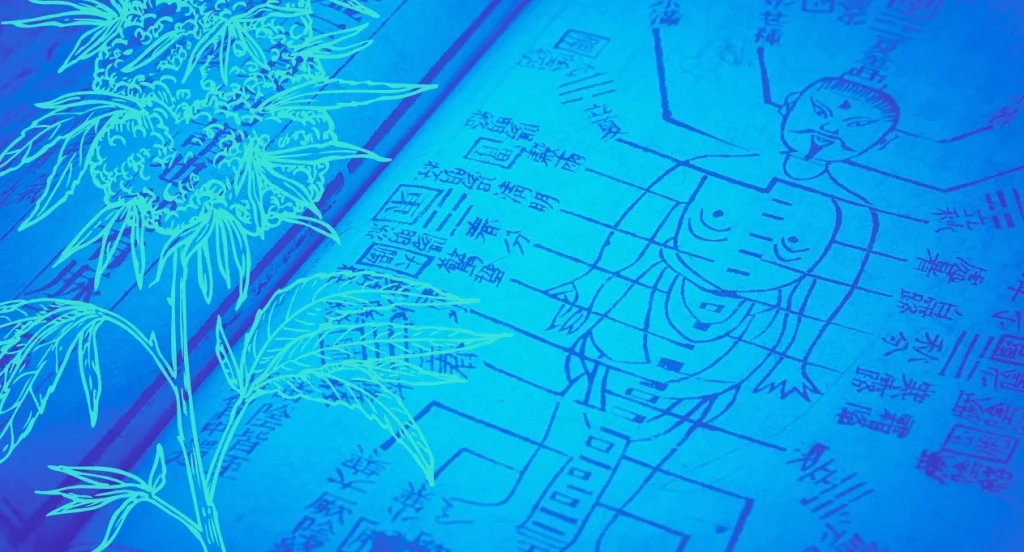
Sometime between the utilitarian rope-and-textile era and the modern pharmacy shelf, someone worked out that this plant did more than clothe the world. The earliest formal record we have of that discovery comes from ancient China. The Shennong Bencaojing, the foundational pharmacopoeia of Chinese medicine, lists cannabis (recorded as ma or dama) as a treatment for pain, inflammation and digestive disorders. It is traditionally attributed to the mythical Emperor Shennong and dated to around 2800 BCE, though the surviving text was compiled several centuries later.
Chinese medicine also gives us the first recorded surgical use of cannabis. Around 200 CE, the physician Hua Tuo is said to have blended cannabis resin with wine to create mafeisan, a compound used to sedate patients before surgery. It is arguably the world’s first documented general anaesthetic, and it predates modern anaesthesia by roughly 1,700 years.
Ancient Egypt tells a similar story from a different direction. The Ebers Papyrus, dated to around 1550 BCE, prescribes cannabis for inflammation and sore eyes, and later Egyptian texts describe it in suppositories for haemorrhoids. In India, the Atharvaveda, one of the four foundational Vedic texts, names bhang (a cannabis preparation) as one of the five sacred herbs that “release us from anxiety”, and Ayurvedic medicine went on to develop dozens of cannabis-based formulations for everything from pain and insomnia to appetite loss.
By the time the Roman Empire was at its height, cannabis was travelling openly along the trade routes. Physicians in the Arab and Persian world, particularly during the Islamic Golden Age, refined its use further and eventually carried it into medieval Europe.
🌱 Fun fact:
In Hua Tuo’s original recipe, the anaesthetic effect came from combining cannabis with wine. The compound’s name, mafeisan, translates roughly as “cannabis boil powder”, which is about as literal as ancient pharmacology gets.
Cannabis meets Western medicine
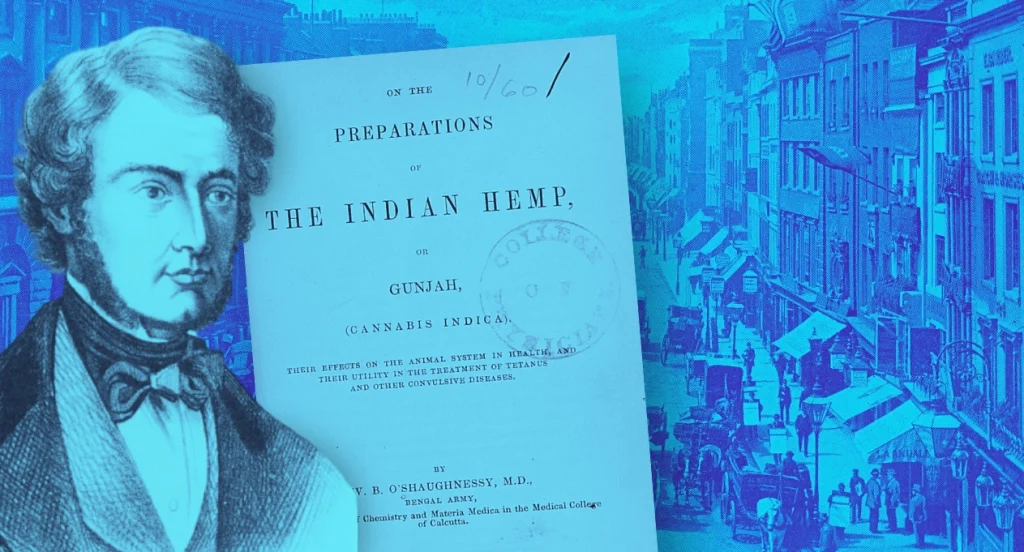
If ancient Asia treated cannabis as ordinary, nineteenth-century Europe treated it as a discovery. The turning point came from a young Irish doctor working in colonial India. William Brooke O’Shaughnessy, stationed in Calcutta in the late 1830s, watched local physicians use bhang and ganja preparations for pain, cramping and convulsions. He experimented, wrote up his findings and in 1843 published On the Preparations of the Indian Hemp, or Gunjah in the Provincial Medical Journal (a forerunner of the British Medical Journal). It was the paper that dragged cannabis into modern Western medicine.
What happened next was a small pharmaceutical gold rush. Between 1839 and 1900, more than 100 scientific articles on cannabis appeared in European and American medical journals. Victorian doctors prescribed it for rheumatism, muscle spasms, epilepsy, migraines, insomnia and menstrual pain. It was sold openly in pharmacies as tinctures, extracts and cigarettes. Queen Victoria’s personal physician, Sir John Russell Reynolds, prescribed cannabis tincture for the monarch’s period pains and later called it “one of the most valuable medicines we possess”.
Cannabis was not a fringe treatment. It sat on the same shelf as morphine and aspirin, and for several decades it was one of the most widely used medicines in the Western pharmacopoeia. That is the point worth holding on to before we get to the twentieth century, because what happened next was not the disappearance of an obscure herbal remedy. It was the dismantling of a mainstream medical tool.
🌱 Fun fact:
O’Shaughnessy did not stop at cannabis. He also introduced intravenous fluid replacement therapy for cholera (still used today), pioneered underwater telegraphy in India and was later knighted. Cannabis, in his career, was almost a side project.
The century of prohibition
Cannabis’s fall from the pharmacy shelf was not gradual. It was engineered.
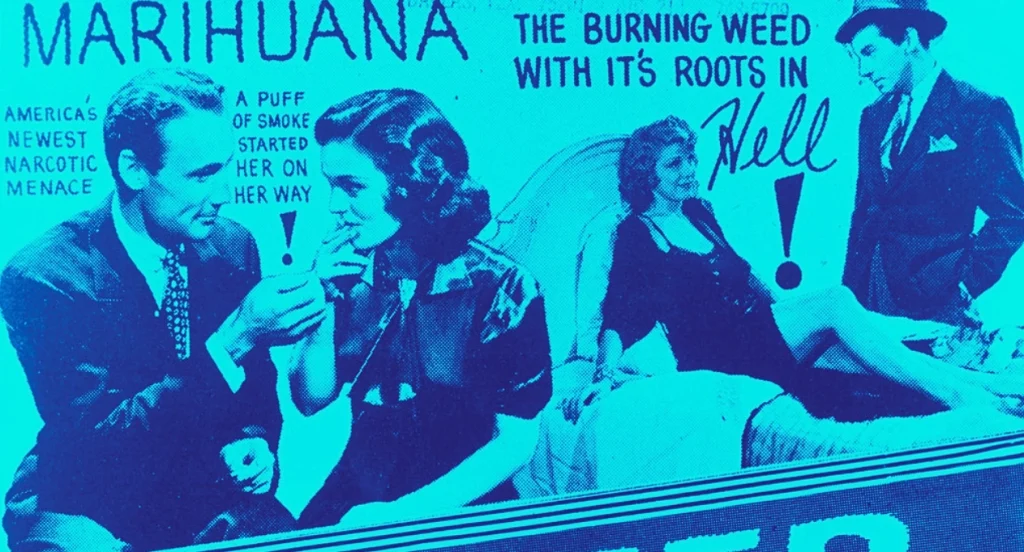
The pivotal moment came in the United States. In 1937, Congress passed the Marihuana Tax Act, championed by Harry Anslinger, the first commissioner of the Federal Bureau of Narcotics. The Act placed a punitive tax on cannabis sale and prescription, effectively criminalising the plant across the country. The public-facing case for prohibition leaned heavily on sensationalised media campaigns linking cannabis to violent crime and racial stereotypes, most infamously the 1936 film Reefer Madness. Behind the scenes, the picture was messier. Powerful industrial interests, including the Hearst newspaper empire (with significant timber holdings threatened by hemp paper) and DuPont (with new synthetic fibres competing against hemp), lobbied hard for cannabis to disappear from the American market.
American policy did not stay American. In 1961, the United Nations adopted the Single Convention on Narcotic Drugs, the treaty that anchors the modern international drug-control system. Cannabis was placed in Schedule IV, the strictest category, alongside heroin. Crucially, that placement was not the result of any scientific review. The World Health Organization has since publicly acknowledged its own historical responsibility for the decision, noting that cannabis was added to Schedules I and IV based on lists submitted without proper critical assessment. The first genuine international scientific evaluation of the plant would not take place until 2018, and it led to cannabis’s removal from Schedule IV in 2020. In other words, cannabis spent nearly sixty years in the world’s strictest drug category on the basis of politics, not evidence.
Anslinger himself was not far from the treaty either. Long after his retirement, he came out of the woodwork in 1967 to lobby the US Senate in favour of the country ratifying the Single Convention, arguing that the treaty could be used to “resist” domestic liberalisation efforts. The same figure who drove the 1937 Act pushed to lock the international rules in behind it.
For the next fifty years, a plant that had spent 10,000 years in continuous human use effectively vanished from mainstream Western medicine. It survived on the margins, in laboratory research and countercultural use, but the pharmacy tinctures were gone, the medical journals fell silent, and a generation of doctors trained without ever prescribing it. That silence is the real reason so much of today’s clinical evidence base still feels thin. The research clock was reset for half a century.
🌱 Fun fact:
The word ‘marijuana’ itself was largely a political choice. Before the 1930s, English-language medical literature almost always used ‘cannabis’ or ‘Indian hemp’. Anslinger’s campaign deliberately popularised the Spanish-language term ‘marijuana’ to make the drug sound foreign, unfamiliar and threatening to English-speaking audiences.
The quiet return
The rehabilitation of cannabis as legitimate medicine did not begin with a headline. It began quietly, in laboratories, and it was cannabis’s own biology that reopened the door.
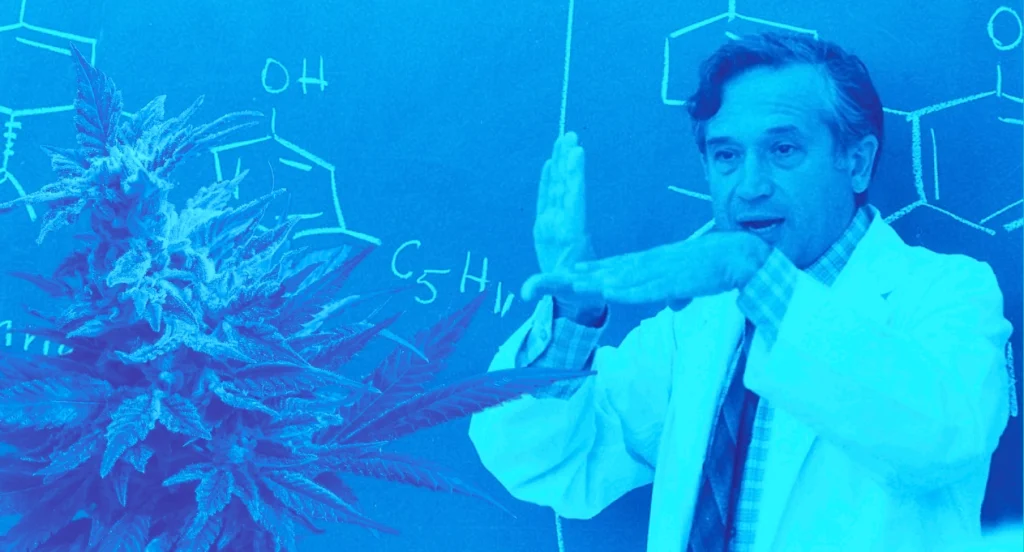
In 1964, the Israeli chemist Raphael Mechoulam and his team at the Weizmann Institute isolated THC for the first time and mapped its structure. He and his colleagues went on to identify CBD and, in the early 1990s, the endocannabinoid system, the network of receptors in the human body that cannabis compounds actually act on. Suddenly there was a concrete biological reason to take the plant seriously again. The pharma industry noticed.
The first modern medicine to come from that revival was Sativex (nabiximols), an oromucosal spray combining THC and CBD, developed by the UK-based GW Pharmaceuticals and approved in Canada in 2005 and then in the UK and Germany from 2010 for multiple sclerosis spasticity. It was the first cannabis-derived prescription medicine to be licensed anywhere in the world. Nine years later, in 2019, the same company won European Medicines Agency approval for Epidyolex, a purified CBD medicine for rare, treatment-resistant childhood epilepsies. Cannabis was formally back on the European pharmacy shelf, this time with a regulatory dossier attached.
Beyond the pharmacy, the geopolitics were also shifting. In December 2013, Uruguay became the first country in the world to fully legalise cannabis for both medical and adult use, a decision framed at the time as a public-health response to organised crime. Canada followed with full adult-use legalisation in 2018. Neither is European, but both mattered: they broke the psychological ceiling that had held since 1961 and forced Europe’s regulators to start thinking seriously about how to design a modern cannabis framework of their own.
National medical markets in Europe followed. Germany legalised medical cannabis in January 2017, allowing doctors to prescribe it for a wide range of conditions and, unusually, requiring statutory health insurers to reimburse it. Italy, the Netherlands (which had operated its state Office of Medicinal Cannabis since 2003), Portugal, Denmark, the Czech Republic and eventually the United Kingdom all built medical frameworks of their own between 2013 and 2018. The pace was gradual, and access varied wildly by country, but the direction of travel was consistent. Cannabis was becoming a regulated medicine again.
Then came the acceleration. Germany’s Cannabis Act (CanG), which took effect in April 2024, removed medical cannabis from the country’s Narcotics Act, freed physicians to prescribe it without special approval and simplified reimbursement. The effect on the market was immediate. Medical cannabis imports into Germany jumped from around 32 tonnes in 2023 to roughly 72 tonnes in 2024, a doubling in twelve months, and the domestic market is now valued at around €420 million with credible projections above €1 billion by 2027. Germany already anchors European medical cannabis and has become a re-export hub supplying Poland, the Czech Republic and the UK.
Ten thousand years of use, a century of prohibition, twenty years of quiet regulatory rebuilding, and now a market moving in months rather than decades. That is the arc.
🌱 Fun fact:
Raphael Mechoulam, often called the ‘godfather of cannabis research’, obtained the very first hashish sample he ever worked with in 1963 by asking a friend at the Israeli police to hand over five kilos of confiscated Lebanese hash. He rode home on the bus with it in a bag. That bag of contraband is where the modern science of cannabinoids started.
Why this history matters for the European industry
The reason to know all of this is not trivia. It is context, and it changes how you read the market.
🟣 The evidence base is younger than the plant. Cannabis has 10,000 years of human use behind it, but only about 60 years of modern pharmacology and barely a decade of properly funded European clinical research. That is why so much of the science still feels incomplete. It is not because the plant is uninteresting; it is because the research clock was reset in 1961.
🟣 The regulation is catching up, not leading. European medical frameworks are being built on top of a UN treaty that admits it made a mistake, a WHO review that only happened in 2018 and a scientific literature that is still being reconstructed. Expect the rules to keep moving. If you work in this industry, regulatory literacy is not optional.
🟣 Stigma is a legacy, not a diagnosis. The suspicion that hangs around cannabis in European clinical settings is the residue of a twentieth-century political campaign, not a considered clinical position. Understanding that helps explain why patients still hesitate to ask, why some doctors still hesitate to prescribe, and why professional communication in this sector matters as much as the science.
🟣 Europe is now the centre of gravity. North America opened the door, but Germany’s 2024 reform, combined with mature medical markets in the UK, the Netherlands, Portugal and a fast-growing pipeline in Poland, the Czech Republic and Italy, has made Europe the most credible medical cannabis region in the world. That is where the specialised roles are being created, and it is where the next decade of the industry will be defined.
This is the map. In the next articles in our Cannabis 101 series, we go deeper into the plant itself, the chemistry, the cultivation, the products and the quality systems that turn all this history into an actual medicine on a European prescription pad.
Frequently asked questions
How old is human use of cannabis?
The earliest archaeological evidence of cannabis in human hands dates to around 10,000 BCE at the Torihama Shell Mound in Japan, where seeds and rope fragments were recovered. The plant most likely originated in Central Asia and spread outward along human trade routes.
Who first used cannabis as medicine?
The oldest formal medical record is the Chinese Shennong Bencaojing, traditionally attributed to Emperor Shennong around 2800 BCE, which lists cannabis for pain, inflammation and digestive disorders. Around 200 CE, the Chinese physician Hua Tuo used a cannabis-and-wine compound called mafeisan as the world’s first documented general anaesthetic.
When was cannabis used in European medicine?
Cannabis entered modern Western medicine in 1843 when Irish doctor William Brooke O’Shaughnessy published his findings in the Provincial Medical Journal, a forerunner of the British Medical Journal. Between 1839 and 1900 more than 100 scientific papers on cannabis appeared in European and American journals, and Queen Victoria’s own physician prescribed cannabis tincture for the monarch.
Why was cannabis criminalised?
Cannabis prohibition was driven by political and commercial forces, not medical evidence. The 1937 Marihuana Tax Act in the United States, supported by industrial lobbying and sensationalised media campaigns, effectively banned the plant. The 1961 UN Single Convention on Narcotic Drugs globalised the ban, placing cannabis in Schedule IV without any prior international scientific assessment, a decision the World Health Organization has since publicly acknowledged as a mistake.
When did medical cannabis return to Europe?
The revival began with Sativex in 2010 (UK/Germany) and Epidyolex in 2019 (EMA-approved). Germany legalised medical cannabis in 2017, then dramatically expanded access with the Cannabis Act (CanG) in April 2024, doubling German medical cannabis imports to around 72 tonnes in a single year and cementing Europe as the world’s most credible medical cannabis region.
References
- The Torihama Shell Mound and Neolithic cannabis in East Asia (Vegetation History and Archaeobotany, Springer)
- Oldest evidence of marijuana use discovered in 2,500-year-old cemetery in the Pamir Mountains (Science / AAAS)
- History of cannabis (Lambert Initiative for Cannabinoid Therapeutics, University of Sydney)
- The early medicinal use of cannabis around the world (Euphoria Wellness)
- Medical cannabis use in ancient civilizations (Certicraft)
- W. B. O’Shaughnessy and the introduction of cannabis to modern Western medicine (The Public Domain Review)
- The remarkable William Brooke O’Shaughnessy, MD (BeyondTHC)
- Getting high with the Victorians: a history of medicinal cannabis (HeadStuff)
- The Rise and Decline of Cannabis Prohibition — Chapter 1 (Transnational Institute)
- Single Convention on Narcotic Drugs, 1961 (original treaty text) (United Nations Office on Drugs and Crime)
- The WHO as actor: the case of cannabis and the Single Convention on Narcotic Drugs 1961 (International Journal of Drug Policy, PMC)
- UN relaxes international control of cannabis, signaling big changes on the horizon (ArentFox Schiff)
- Anslinger’s treaty trap (On Drugs)
- Scientist known as ‘godfather of cannabis research’ dies at 92 (PBS NewsHour, on Raphael Mechoulam)
- Sativex: UK first approval worldwide for cannabis-derived prescription medicine (GW Pharmaceuticals)
- Epidyolex — European Medicines Agency EPAR (EMA)
- Uruguay becomes first country to legalize marijuana trade (Reuters)
- Germany cannabis legalisation: the business guide 2026 (Cannabis Europa)
- Germany medical cannabis legislation and market data (Prohibition Partners)
- Sativa vs indica: the real difference (The Cannigma — used in the hemp vs cannabis callout)



 English (UK)
 Deutsch