

For decades, cannabis has been sold under three familiar names: sativa, indica and ruderalis, plus the endless hybrids in between. The problem is that most of what the industry means by those labels does not match what the botanists actually described. Genetic research increasingly points to a single species with many variations, which is why serious cultivators and regulators are quietly moving toward better vocabulary: cultivar, and even more accurately, chemovar. Understanding all of this is the difference between reading a strain menu and reading a certificate of analysis.
Walk into any European medical cannabis pharmacy or clinic and you will see the same three words repeated on packaging, in patient conversations and in marketing decks: sativa, indica, hybrid. Sometimes ruderalis makes an appearance too. These labels are so ubiquitous that most people, patients and professionals alike, assume they refer to something scientifically settled. They do not.
The story of how cannabis got classified, and how the industry then quietly rewrote that classification for its own purposes, is one of the more interesting botanical tangles of the last hundred years. It also has real commercial consequences. If you are prescribing, cultivating, extracting, testing or regulating cannabis in Europe, the terminology you use tells your colleagues a lot about how seriously you take the plant.
This is the fourth article in our Cannabis 101 series. In the previous article we looked at the anatomy of the plant from roots to trichomes; here we look at how that plant has been named, categorised and re-categorised, and at what modern science is actually telling us to say instead.
The three "types" everyone talks about
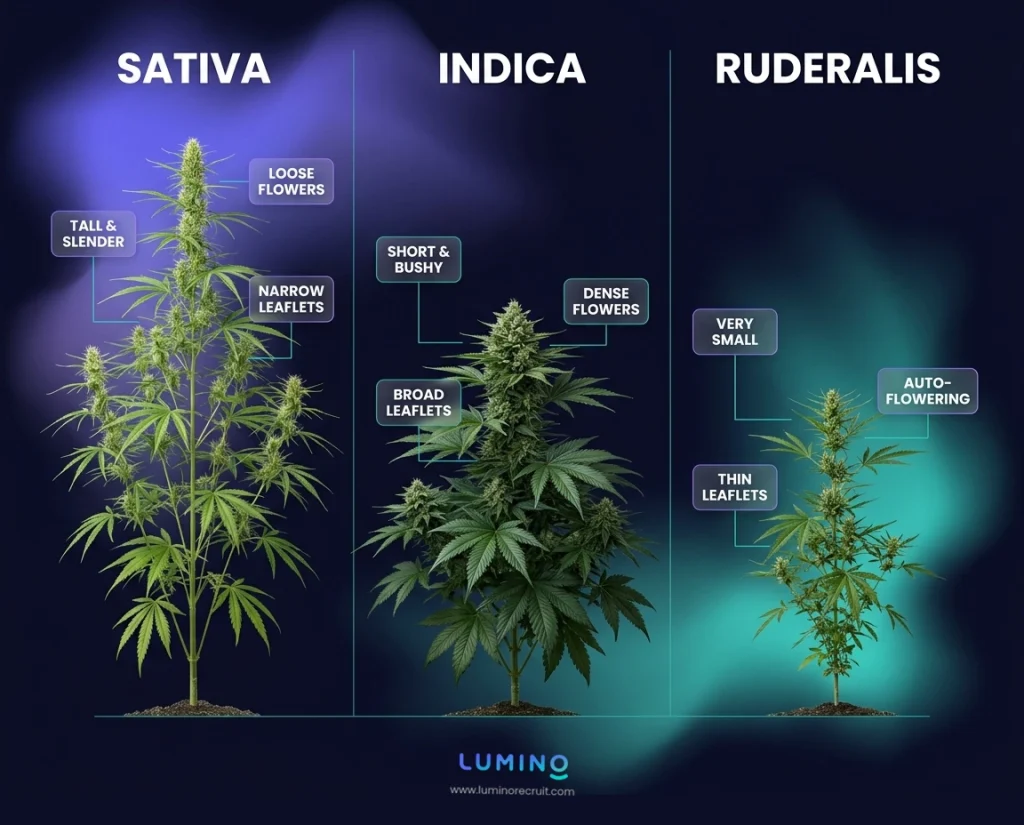
The familiar sativa/indica/ruderalis trio comes from three different botanists working across three different centuries.
🟣 Cannabis sativa was formally described by the Swedish botanist Carl Linnaeus in 1753, based on tall, fibrous hemp plants growing across Europe. Linnaeus was largely thinking about industrial hemp (rope, textile, seed) rather than about medicine or psychoactivity.
🟣 Cannabis indica was described by the French naturalist Jean-Baptiste Lamarck in 1785, from specimens collected in India that looked and behaved distinctly differently: shorter, bushier, with broader leaflets and, crucially, noticeably more psychoactive resin.
🟣 Cannabis ruderalis was added much later by the Russian botanist Dmitrij Janischewsky in 1924, based on wild-growing populations in southern Russia and Central Asia: small, weedy, hardy plants with a very low THC content and, uniquely, an auto-flowering habit that made them independent of day-length changes.
In modern industry usage, however, the meanings have drifted. When a dispensary or clinic today says “sativa” they usually mean an effect profile (energising, cerebral, daytime), and when they say “indica” they usually mean the opposite (sedating, physical, night-time). This effect-based shorthand has almost nothing to do with the original botanical descriptions. It was largely popularised by American and Dutch breeders in the 1980s and 1990s, based on grower folklore rather than clinical evidence.
A useful trick to keep this straight: when the term is italicised (Cannabis sativa, Cannabis indica) it is talking about the historical botanical species; when it is used in ordinary type (“sativa”, “indica”) it is almost always talking about the industry shorthand for effect. The two are related but should not be confused.
🌱 Fun fact:
Lamarck’s original description of Cannabis indica in 1785 listed eight distinct morphological features that separated it from Linnaeus’s Cannabis sativa, from stalk thickness to leaflet width to flower structure. Almost none of those features are what modern budtenders or patients think of when they hear the word “indica” today.
Why the sativa vs indica binary is basically wrong
Here is the uncomfortable truth for anyone who has spent years talking about “sativas” and “indicas”: modern genetic research does not support the split.
When researchers actually sequence the genomes of hundreds of commercial cannabis samples labelled as “sativa”, “indica” or “hybrid”, the labels turn out to be very poor predictors of the plant’s actual genetics. Samples marketed as “pure sativa” and samples marketed as “pure indica” often overlap almost entirely at the DNA level, and two plants sold under the same brand-name “strain” in different dispensaries can be genetically further apart than plants sold under supposedly different types.
A 2015 study by Sawler and colleagues, which analysed 81 samples of drug-type cannabis and 43 samples of hemp, found only a weak correlation between reported “sativa vs indica” ancestry and actual genetic ancestry. A 2023 review in the journal Genome went further and argued that decades of hybridisation have made the traditional categories almost meaningless for modern medical cannabis, and that the industry should treat cannabis as effectively a single, highly variable species with many cultivars.
The effect-based version of the split is on even shakier ground. There is no consistent scientific evidence that all so-called “indicas” are sedating and all so-called “sativas” are stimulating. The variation in effect within either category is far larger than the variation between them, and much of the perceived difference is better explained by cannabinoid ratios (THC-to-CBD balance) and terpene profiles (the chemistry we covered in Article 3) than by whether a plant looks tall and skinny or short and bushy.
None of this means the words are useless. They are convenient shorthand, and everyone in the sector uses them. But it is worth knowing that they are shorthand and not science, especially if you are writing patient-facing material, product labels or regulatory documents. In those settings, precision protects you.
🌱 Fun fact:
In a widely cited 2015 study, cannabis researcher John McPartland surveyed dispensary-labelled “sativa” and “indica” plants and concluded that the two supposed categories were essentially indistinguishable on any consistent morphological or genetic basis, calling the industry classification “vernacular” rather than scientific. Almost a decade later, the labels are still on every shelf.
What ruderalis actually is
Ruderalis is the least glamorous member of the family, but from a commercial cultivation point of view it might be the most useful.
Cannabis ruderalis, described in 1924 by Dmitrij Janischewsky from wild populations growing along roadsides and disturbed land in southern Russia and Central Asia, is a small, hardy, weed-like plant that most people would walk straight past. It rarely grows above one metre, produces very little resin, and contains almost no THC. In pure form it has essentially zero recreational or medical value. So why does anyone care about it?
Two reasons: auto-flowering and hardiness.

Every “photoperiod” cannabis plant, meaning almost every sativa or indica ever sold, switches from vegetative growth to flowering in response to changes in day-length. This is why outdoor growers plant in spring, wait for the light to shift after midsummer, and harvest in autumn, and why indoor cultivators simulate that shift with lighting schedules of 18-hours-on then 12-hours-on. Ruderalis, having evolved at very high northern latitudes where summers are short and light does not change dramatically, does not care. It flowers automatically after about 3–4 weeks of vegetative growth, regardless of the light schedule. That trait is called auto-flowering.
On top of that, ruderalis is genetically extremely hardy, tolerating cold, poor soils and short growing seasons that would kill a delicate medical cultivar.
Modern breeders realised, sometime in the 1980s, that if they crossed a ruderalis with a high-THC sativa or indica, they could pass the auto-flowering and hardiness traits into a plant that also produced meaningful cannabinoids. That is where auto-flowering hybrids come from. Today they are the backbone of many outdoor and small-scale European cultivation operations, precisely because they compress the cultivation cycle from around six months down to about 10–12 weeks from seed to harvest.
So ruderalis on its own is almost useless. Ruderalis genetics blended carefully into a modern hybrid, however, is one of the quiet engineering feats of the last forty years of the cannabis industry.
🌱 Fun fact:
The word “ruderalis” comes from the Latin rudera, meaning rubble or debris. It refers not to the plant itself but to the disturbed, rough, roadside habitats where these wild populations were first found. The plant literally got its name from the fact that it liked growing in the mess humans left behind.
Hybrids: what the industry actually sells
If sativa and indica are shaky categories and pure ruderalis is essentially unusable, what is actually on the shelf in a modern European pharmacy or clinic? The answer, almost without exception, is a hybrid.
A hybrid is any cannabis plant produced by crossing two or more genetic lines. In practice, more than 95% of commercial medical and adult-use cannabis today is hybrid, a product of decades of selective breeding that mixed original landrace sativas from equatorial regions with landrace indicas from the Hindu Kush and, in many cases, a splash of ruderalis for auto-flowering and hardiness. The “pure sativa” or “pure indica” advertised on the label is almost always a marketing simplification.
Hybrids are usually grouped into three loose commercial categories:
🟣 Sativa-dominant hybrids carry mostly “sativa” ancestry in their pedigree and are typically marketed for daytime, uplifting effects. They tend to be taller, take longer to flower, and are often preferred for use during working hours.
🟣 Indica-dominant hybrids carry mostly “indica” ancestry and are marketed as more sedating and physically relaxing. They tend to be shorter, flower faster, and are often positioned for evening use, sleep or pain management.
🟣 Balanced hybrids sit somewhere in the middle, often described as producing effects that neither fully stimulate nor fully sedate.
Two things to keep in mind here. First, these are still the industry’s shorthand categories, not scientifically rigorous ones. A “sativa-dominant hybrid” grown by one breeder can behave very differently from a “sativa-dominant hybrid” grown by another. Second, the specific effect any patient or consumer experiences depends far more on the cannabinoid ratios and terpene profile of the finished product than on which hybrid category it was slotted into.
This is why serious medical cultivators, and increasingly serious regulators, are moving toward describing products not by their hybrid category at all, but by their measured chemical profile: THC and CBD percentages, dominant terpenes, cannabinoid ratios. That approach removes the marketing layer and forces the conversation onto the same chemistry every prescription is actually calibrated against.
🌱 Fun fact:
Some of the most famous “strains” in cannabis history were accidents. The legendary hybrid Skunk #1, released by American breeder Sam “the Skunkman” Selezny in the late 1970s, was originally a chance three-way cross between Afghani indica, Mexican sativa and Colombian sativa, and it went on to become the genetic ancestor of most modern medical hybrids grown in Europe today. Almost every plant on a European medical pharmacy shelf traces some percentage of its DNA back to that one 1970s cross.
Cultivar vs strain vs chemovar: the terminology upgrade
If sativa and indica are marketing shorthand rather than science, what should serious professionals be using instead? This is where the sector is quietly changing its vocabulary, and it is worth learning the three terms that are gradually replacing “strain”.
🟣 Strain is the word every dispensary, budtender and casual consumer uses. It has no formal botanical meaning. The term was borrowed from microbiology, where it refers to genetic variations within bacteria and viruses, and it does not sit anywhere on the botanical taxonomy ladder. It is convenient, it is universal, and it is not scientifically defensible.
🟣 Cultivar, short for cultivated variety, is the botanically correct term for a plant that has been selectively bred for specific traits and can be reliably reproduced with those traits intact. Every named cannabis variety on a modern European medical shelf is technically a cultivar. The word is standard across every other agricultural sector (roses, apples, wheat, tomatoes), and cannabis is finally catching up.
🟣 Chemovar, short for chemotaxonomic variety, goes one step further. A chemovar is a classification based not on genetics or physical appearance but on measured chemical composition, typically the top 1–2 cannabinoids and the top 2–4 terpenes in a given batch. Two plants can be the same cultivar on paper but produce meaningfully different chemovars depending on how and where they were grown, which is exactly the kind of variation a prescriber needs to know about.
The direction of travel across serious European operators, and particularly across EU-GMP-certified producers, is away from “strain” and towards “cultivar” for the plant, and towards “chemovar” for the product. A patient prescription that says “20% THC, 1% CBD, myrcene-dominant” is far more actionable than one that says “OG Kush”. The first tells a clinician what the medicine will actually do; the second tells them a name a breeder made up in the 1990s.
This is not a purely academic upgrade. As European medical regulators tighten labelling requirements and clinical prescribing standards over the next few years, expect “chemovar” and “cultivar” to appear on more and more product documentation, and expect “strain” to survive mainly on informal patient-facing communications.
🌱 Fun fact:
The word “cultivar” was formally coined by American horticulturist Liberty Hyde Bailey in 1923 to bring some order to the chaotic naming of ornamental plants. A century later, cannabis is one of the last major crops still catching up to the vocabulary Bailey invented for tulips and apples.
Why this taxonomic mess matters for the European cannabis industry
Terminology might sound like an academic side quest, but in the European medical cannabis market it has direct consequences for the people building, prescribing, regulating and buying products. Each role we have discussed across the series feels this in a slightly different way:
🟣 Cultivators need to know that “sativa” and “indica” tell a customer very little about their plant. Serious breeders now build brand credibility on documented cultivars with stable genetics and reproducible chemistry, not on marketing-department names.
🟣 Extraction technicians and formulators are increasingly designing products around chemovar profiles (specific cannabinoid and terpene ratios) rather than around a flower’s supposed sativa or indica lineage. That is the only classification that survives the extraction process.
🟣 Quality control and laboratory teams are the ones actually assigning chemovars. A certificate of analysis showing “22.4% THC, 0.8% CBD, dominant terpenes myrcene / limonene / caryophyllene” is a chemovar description, whether it is labelled that way or not.
🟣 Prescribers and pharmacists are moving away from asking “is this a sativa or an indica?” and toward asking “what is the THC:CBD ratio and terpene profile?”. That shift matters especially in Germany, the UK, Portugal and the Netherlands, where medical prescribing is expanding fastest.
🟣 Compliance and regulatory professionals are watching EU-GMP labelling standards trend firmly toward chemical descriptors and away from vernacular “strain” names. Getting ahead of that shift is a hiring differentiator across the sector right now.
The bottom line is that the industry is still using two languages at once: a legacy marketing language of sativas, indicas and strains, and an emerging scientific language of cultivars, chemovars and cannabinoid ratios. Being fluent in both, and knowing when to use which, is one of the most useful skills a professional entering European medical cannabis can bring to the table.
In the next articles in our Cannabis 101 series we move from the plant’s identity into its lifecycle: how these cultivars are actually grown from seed to harvest, then what products they become, how they are extracted, and finally the quality systems that turn all of this into a regulated European medicine.
Frequently asked questions
What is the difference between sativa, indica and ruderalis?
Historically, they are three separate botanical descriptions: Cannabis sativa (Linnaeus, 1753), tall and fibrous; Cannabis indica (Lamarck, 1785), shorter, bushier and more psychoactive; and Cannabis ruderalis (Janischewsky, 1924), small, hardy, low-THC and auto-flowering. In modern industry usage, “sativa” and “indica” have been repurposed to describe alleged effect profiles (energising vs sedating), which is largely marketing shorthand and not scientifically supported.
Is the sativa vs indica distinction scientifically accurate?
No. Genetic research consistently finds that commercial “sativa” and “indica” samples overlap heavily at the DNA level, and that the perceived effect differences are better explained by cannabinoid ratios (THC:CBD) and terpene profiles than by which category a plant is filed under. The industry treats the two labels as convenient shorthand, not as botany.
What is a cannabis hybrid?
A hybrid is a cannabis plant produced by crossing two or more genetic lines. More than 95% of commercial medical cannabis today is hybrid. Hybrids are usually described as sativa-dominant, indica-dominant or balanced, but these categories are also loose commercial shorthand rather than strict science.
What is the difference between a strain, a cultivar and a chemovar?
Strain is informal, borrowed from microbiology, and has no botanical status. Cultivar (cultivated variety) is the botanically correct term for a selectively-bred, reproducible variety of plant. Chemovar (chemotaxonomic variety) classifies a plant based on its measured chemical composition, typically its top cannabinoids and terpenes. Serious European operators are moving from “strain” toward “cultivar” and “chemovar”.
Why does ruderalis matter if it has almost no THC?
Because breeders can cross ruderalis with a high-THC cultivar to produce auto-flowering hybrids that inherit ruderalis’s day-length independence and cold-hardiness while still producing meaningful cannabinoids. This compresses the cultivation cycle from about six months down to 10–12 weeks and underpins a large share of modern European outdoor and small-scale cultivation.
References
- Genomics-based taxonomy to clarify cannabis classification (Genome, Canadian Science Publishing, 2023)
- Models of cannabis taxonomy, cultural bias, and conflicts between scientific and vernacular names (McPartland and Small, Botanical Review)
- Cannabis sativa and Cannabis indica versus “Sativa” and “Indica” (McPartland)
- The genetic structure of marijuana and hemp (Sawler et al., PLOS ONE, 2015)
- Cannabis taxonomy update: what do indica, sativa and ruderalis mean? (Trichome Institute)
- Cannabis cultivars vs chemovars vs chemotypes: a breakdown (Royal Queen Seeds)
- Cannabis: strains vs cultivars (Terpenes and Testing Magazine)
- Understanding the terminology: cultivar vs strain in cannabis classification (Greenway Magazine)
- Cultivar vs chemovar: how cannabis strains should really be classified (Modern Canna)
- The ‘entourage effect’: what we don’t know about how cannabis works (The Conversation)
- Cannabis plant anatomy: a field guide from roots to trichomes (Lumino, Cannabis 101, Article 2)
- THC, CBD and terpenes: the chemistry behind cannabis (Lumino, Cannabis 101, Article 3)




 English (UK)
 Deutsch