

The cannabis plant is more organised, and more strategic, than it looks. Only the female plant produces the resinous flowers where almost all of the plant’s psychoactive and therapeutic compounds, THC, CBD and their companion cannabinoids and terpenes, are concentrated. Almost all of that active chemistry is made inside microscopic glands called trichomes that sit on the surface of a specific set of tissues. Understanding the plant’s anatomy, from root to trichome, is the foundation on which every serious cultivator, extractor and quality specialist in the European industry builds their work.
Look at a mature cannabis plant and it is easy to see a fuzzy green blur of leaves, flowers and hairs. Look closer, and the plant is doing something surprisingly precise. It grows in tidy nodes. It sends its most valuable output to a handful of specific structures. It sorts males from females. And it produces almost all of its cannabinoids and terpenes inside tiny mushroom-shaped factories on the surface of its buds. Once you can name those parts, everything from a cultivation SOP to a certificate of analysis stops looking like jargon.
This is the second article in our Cannabis 101 series, a plain-English guide for professionals stepping into the European sector. In the first article we covered the 10,000-year history of cannabis, from ancient medicine to modern prohibition and the current European revival; here we look at the plant itself. Whether you are auditing a Portuguese cultivator, writing a prescription in Berlin, or evaluating a new cultivar for a UK clinic, the anatomy is where the conversation starts. We are not aiming for a botany degree, we are aiming for the mental model you actually need to make sense of the market.
The general anatomy: shared by every cannabis plant
Before we get into what makes a female cannabis plant medically valuable, it helps to know the parts that every cannabis plant, male or female, has in common. These are the structural, vegetative components: the skeleton on which the plant’s more interesting reproductive chemistry is later built.
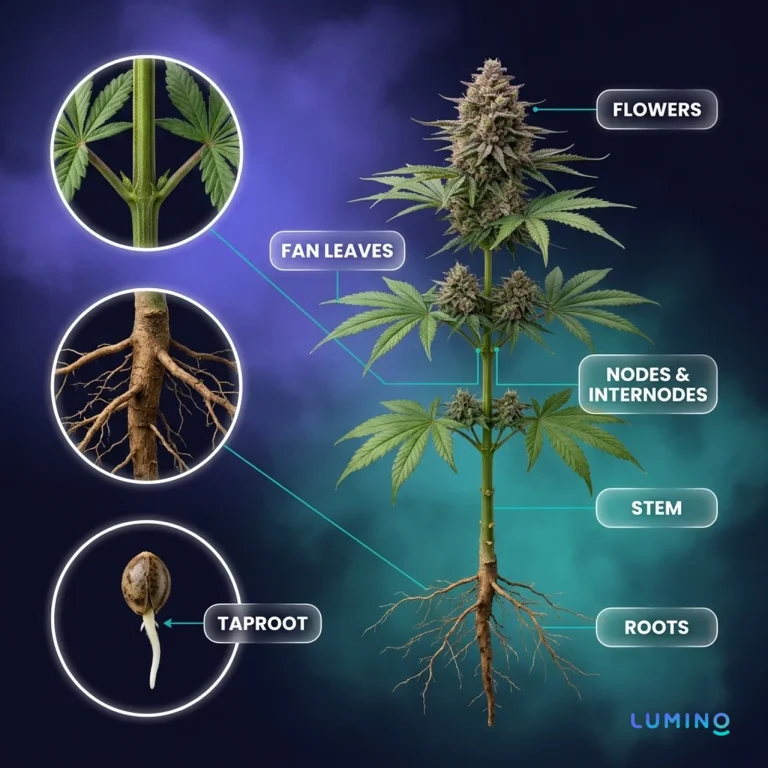
🟣 Roots. When a cannabis seed germinates, the first thing to emerge is a single primary root called the taproot, which grows straight down and anchors the plant. As the plant matures, secondary and tertiary lateral roots branch off the taproot, forming a wider fibrous network that does most of the water and nutrient uptake. The taproot itself does not disappear; it remains the plant’s central anchor for its whole life. (Worth noting: cannabis grown from a clone, meaning a cutting rather than a seed, has no taproot at all, only fibrous adventitious roots, which is one reason clones behave differently in the ground.) Roots also host beneficial microbes that affect vigour and terpene expression, which is why modern cultivators pay close attention to substrate, oxygenation and irrigation timing.
🟣 Stem. The central stalk carries water and sugars between the roots and the leaves, and gives the plant the mechanical strength to hold up its flowers. Hollow at maturity and fibrous throughout, it is the same tissue that has been spun into hemp rope and textiles for thousands of years.
🟣 Nodes and internodes. A node is the point on the stem where branches and leaves emerge; the space between nodes is the internode. Node spacing is a useful proxy for growth style. Tightly-spaced nodes usually mean a shorter, denser plant; long internodes suggest a taller, stretchier one. This is often the first thing an experienced grower notices when they walk into a flowering room.
🟣 Fan leaves. The large, iconic seven-fingered leaves are the plant’s solar panels. They contain almost no cannabinoids and are usually trimmed away at harvest, but they are the engine of photosynthesis and the first place stress shows up (yellowing, curling, spotting). For that reason, fan leaves are one of the main things a cultivator watches every day. They are effectively the plant’s dashboard, and any change in colour, posture or texture is an early signal that something in the environment (light, nutrients, water, pests or disease) needs attention.
🟣 Flowers. At maturity, the plant develops flowers at the tips of its branches. Every cannabis plant produces flowers, but what those flowers look like, and what they contain, depends entirely on whether the plant is male or female. That distinction is where cannabis stops looking like an ordinary herb and starts looking like a medical crop, and it is what the next section is about.
🌱 Fun fact:
The iconic seven-fingered cannabis leaf is a marketing image, not a botanical rule. Cannabis leaflets can range from 3 to 13 fingers depending on genetics, plant age and position on the plant, and the very first “true leaves” a seedling produces almost always have just a single blade.
Male vs female: why sex matters
Cannabis is one of a small group of plants that is naturally dioecious, meaning individual plants are either male or female, rather than carrying both reproductive systems on the same plant. That simple biological quirk turns out to be one of the most commercially important facts in the whole industry.
🟣 Male plants produce small, pollen-filled sacs at the nodes, roughly the shape and size of a grain of rice. When they mature, these sacs split open and release pollen into the air. Male flowers contain very low levels of cannabinoids and are not used to make medicine. Their job in a commercial setting is purely genetic: to fertilise females in a controlled breeding programme, or to be removed from the room before they can do so.
🟣 Female plants produce the dense, resinous flowers we usually call buds. These flowers are where almost all of the plant’s cannabinoids and terpenes are concentrated, and they are what medical extracts, dried flower prescriptions and finished cannabis products are made from. In a commercial cultivation environment, the entire crop is female.
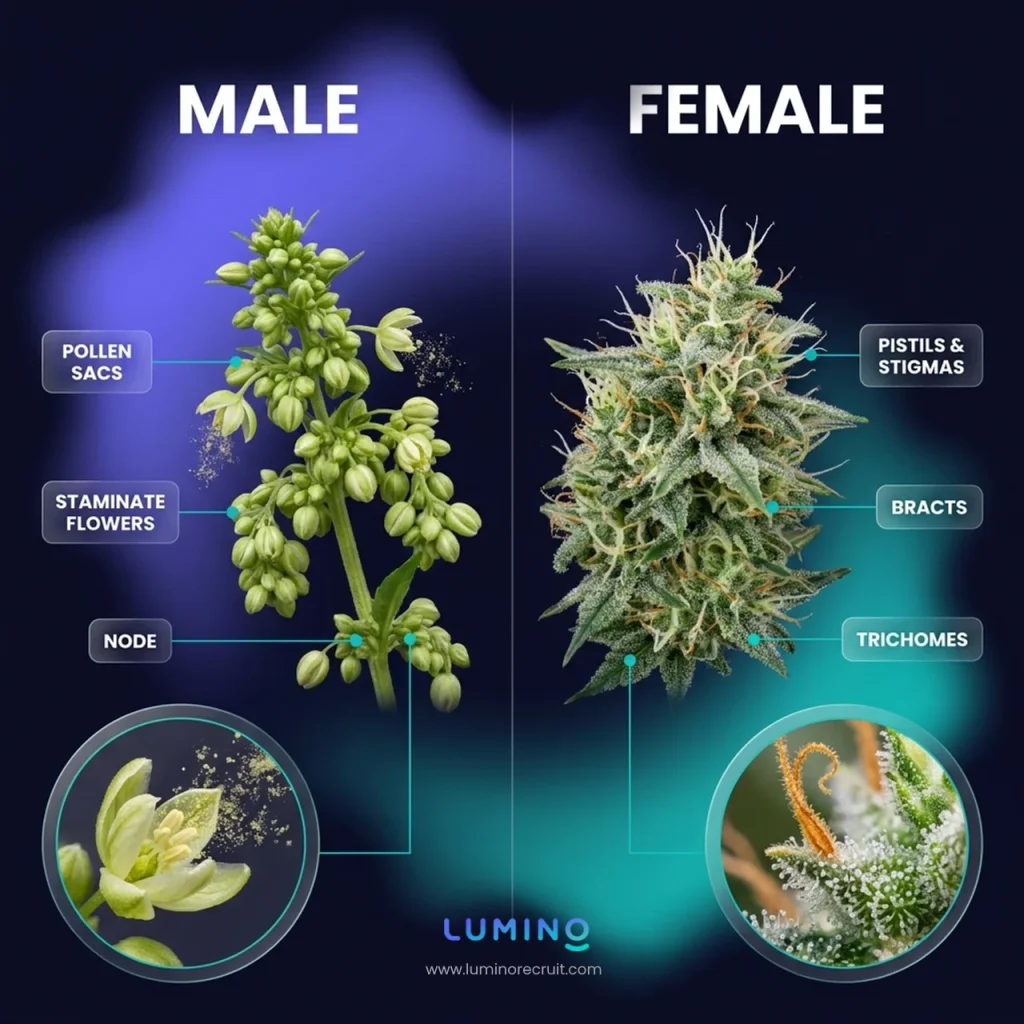
If a male plant is left in a room of females, it will pollinate them. Once a female is pollinated, she stops directing her energy into resin production and starts making seeds instead. Seeded flower is dramatically less potent, less aromatic and less valuable than seedless flower. This is why professional medical cultivators go to significant lengths, growing from feminised seeds or clones, sexing every plant early, and removing any males immediately, to keep their rooms completely male-free.
A quick related term you will hear on any cultivation floor: sinsemilla, from the Spanish sin semilla meaning “without seed”, is the name for the high-potency, unpollinated female flower that medical and premium markets are built on. Every gram of medical cannabis dispensed in Europe today is essentially sinsemilla.
There is one further complication worth knowing. Under environmental stress (heat, light interruption, physical damage), a female plant can occasionally produce a small number of male flowers on her own tissue. This is called hermaphroditism, and it can pollinate a room from within. Preventing it is one of the reasons a well-run medical grow environment is so obsessive about consistency in temperature, humidity and light cycle.
🌱 Fun fact:
The word “sinsemilla” entered English through 1970s Californian growers importing genetics and techniques from Mexico. Today it is used matter-of-factly in European medical cultivation documents, quietly carrying its Spanish grammar into pharmaceutical-grade paperwork.
The female flower up close
Now that we know why we care about the female plant, it is worth looking at what her flowers are actually made of. This is where most of the vocabulary you will see on lab reports, cultivation SOPs and product packaging lives.
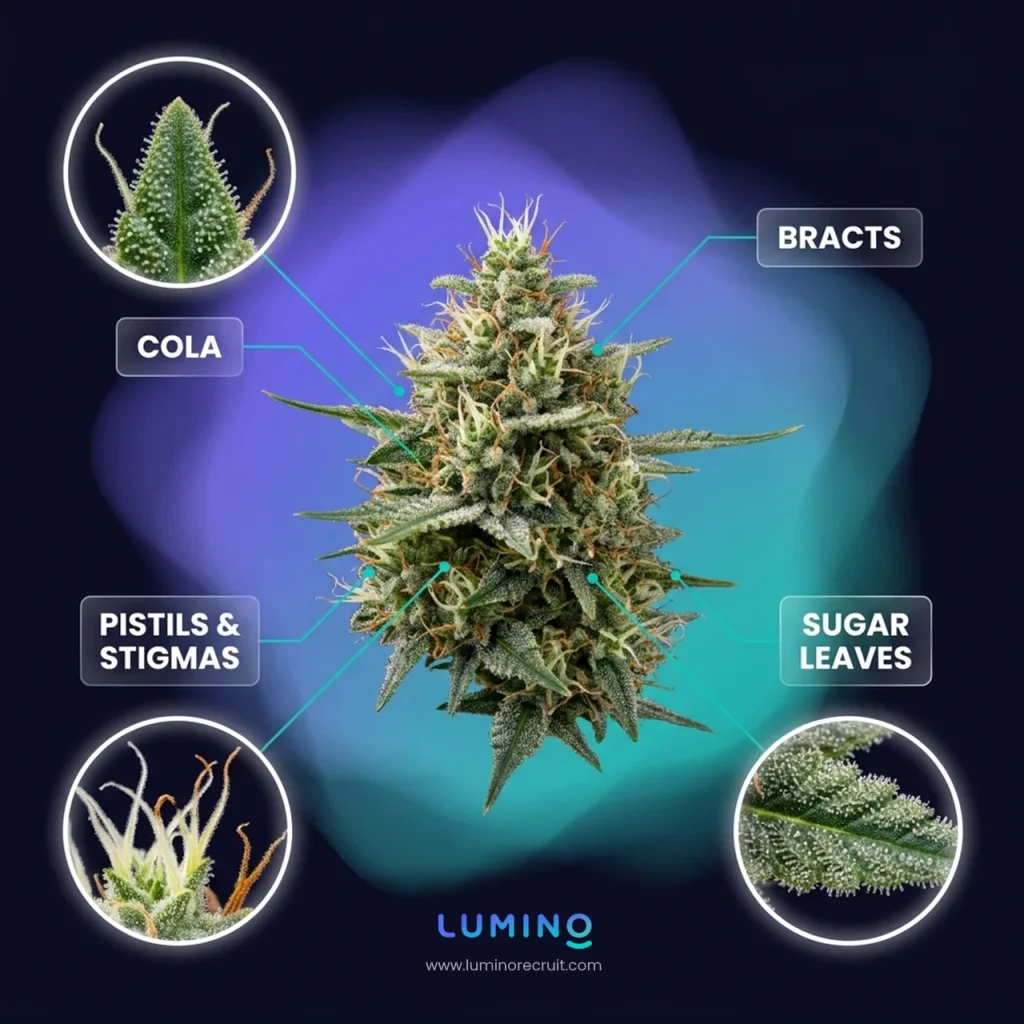
🟣 Cola. The cola (from the Spanish for “tail”) is the cluster of flowers that forms at the top of a main stem or branch. The largest, densest cola sits at the very top of the plant and is often called the apical cola or main cola; smaller secondary colas grow along the tips of side branches. Colas develop where the plant receives the most light, and they carry the highest concentrations of cannabinoids and resin.
🟣 Bracts (often called calyxes). Zoom into a cola and it is really a stack of small, tear-shaped structures called bracts. Each bract is a leaf-like envelope that surrounds and protects the plant’s ovule (the potential seed site). Bracts are, technically speaking, the most cannabinoid-rich tissue on the whole plant, because they are absolutely coated in trichomes. Most people in the industry casually call them calyxes, which is botanically incorrect but universally understood, so both terms show up in industry writing.
🌱 Fun fact:
What everyone in the industry calls a “calyx” is technically the wrong word. In real botany, a calyx is the little green cup at the base of a flower (think of the leafy part that holds up a rose). Cannabis flowers do not actually have one. The tear-shaped piece we point at is really a bract, a modified leaf that wraps around the seed site. The mix-up stuck simply because early cultivators borrowed the closest-sounding word they knew, and by the time botanists corrected them it was already on every grow guide and product label.
🟣 Pistils and stigmas. From each bract, two thin hair-like structures poke out. These are the stigmas, and together with the ovule below they form the plant’s female reproductive organ, the pistil. Their evolutionary job is to catch airborne pollen. In young flowers they are bright white and stand straight up; as the flower matures they curl inward and change colour, first to yellow, then to orange, then to red-brown. That colour shift is one of the oldest visual cues cultivators use to judge ripeness and decide when to harvest.
🟣 Sugar leaves. Between and around the bracts, a set of small pointed leaves grow directly out of the flower itself. These are the sugar leaves, named for the frosty-looking coating of trichome resin that gives them a sugar-dusted appearance. Unlike fan leaves, sugar leaves carry meaningful cannabinoid content. In post-harvest processing they are usually trimmed off the flower and set aside for extract production rather than discarded, because they are chemically valuable in their own right.
Put all of that together and a mature cola is a densely packed architectural stack: bracts holding ovules, stigmas reaching out to catch pollen that will never come (in a well-managed room), and sugar leaves shading the whole thing, all of it coated in the trichomes we will look at next.
🌱 Fun fact:
The colour change of stigmas from white to orange-brown is caused by the same class of pigments that turn autumn leaves red. It is largely a signal of maturity rather than a sign of chemistry, which is why serious cultivators judge harvest timing with a microscope aimed at the trichomes rather than by eyeballing the stigmas alone.
Trichomes: where the medicine is actually made
If the female flower is the medically valuable part of the plant, then trichomes are the medically valuable part of the flower. Everything else, roots, stems, leaves, bracts, is essentially infrastructure to hold up and support these microscopic factories.
Trichomes are tiny, mushroom-shaped glands on the surface of the bracts, sugar leaves and (to a lesser extent) fan leaves near the flower. Each one is a self-contained little bioreactor: it synthesises and stores the cannabinoids and terpenes we covered in Article 3 inside its bulbous head. Under the right light, mature trichomes give a flower its unmistakable frosty, glittering appearance.
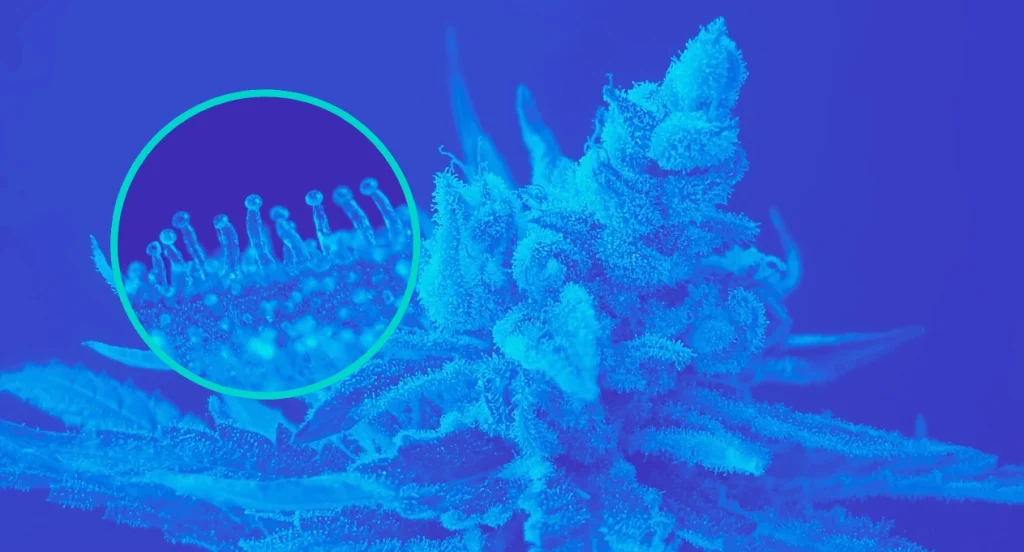
Not all trichomes are the same, and it is worth knowing the three main types because they show up in cultivation notes, harvest decisions and lab reports.
🟣 Bulbous trichomes are the smallest, measuring only around 10 to 15 microns, invisible to the naked eye. They cover most of the aerial parts of the plant and contribute a modest amount to overall cannabinoid and terpene production.
🟣 Capitate-sessile trichomes are the mid-sized ones, around 20 to 30 microns across, shaped like tiny mushrooms with a bulbous head sitting on a very short base. They produce cannabinoids throughout the plant’s life but at lower concentrations than the largest type.
🟣 Capitate-stalked trichomes are the workhorses. They are up to 500 microns tall, just about visible without a microscope, and consist of a long stalk topped by a bulbous head. A 2019 University of British Columbia study confirmed that these are the richest source of THC- and CBD-producing enzymes, and the largest producers of terpenes. When people talk about “the trichomes” that give a flower its potency and aroma, they almost always mean these.
Ripeness is judged mostly by looking at those capitate-stalked trichomes under a microscope. As the plant matures, the heads shift from clear (early, still developing) to milky-white (peak cannabinoid content, ideal for most medical use) and finally to amber (over-ripe, cannabinoids beginning to degrade into more sedating byproducts). That colour progression is what lets a skilled cultivator time a harvest to within a couple of days.
🌱 Fun fact:
Trichomes are not unique to cannabis. Most flowering plants have some form of them. What is unusual is what cannabis chose to do with them. In cannabis, trichomes evolved as a defence system, producing sticky, bitter, aromatic compounds to deter grazing animals and insects. Those same defensive compounds turned out to be the cannabinoids and terpenes that now anchor a multi-billion-euro medical industry. In other words, an entire European market is built on the plant’s chemical warfare against caterpillars.
Why cannabis anatomy matters to jobs in the European cannabis industry
Each piece of the plant we have just walked through maps directly onto a specific job, decision or document in the modern European industry:
🟣 Cultivators live and die by node spacing, canopy structure, sexing, hermaphroditism and trichome maturation. Every one of those is an anatomy call, made daily, that determines a room’s final yield and cannabinoid profile.
🟣 Extraction technicians decide which parts of the plant go into which process. Flower and sugar leaves are treated very differently from stems and fan leaves. Understanding where the trichomes actually sit is what separates a valuable extract from an expensive mistake.
🟣 Quality control and laboratory teams rely on anatomical vocabulary to describe samples on a certificate of analysis, to distinguish flower material from trim, and to justify why one batch tests higher than another.
🟣 Prescribers and pharmacists, particularly in Germany, the UK, Portugal and the Netherlands, increasingly need to understand product formats (flower, extract, oil, granulate) and where they came from anatomically, to answer patient questions credibly.
🟣 Compliance and regulatory professionals working under EU-GMP and GACP rules read cultivation and processing SOPs where every one of these terms shows up. Getting the plant’s biology wrong on paper is one of the fastest ways to fail an audit.
That is why anatomy sits so close to the top of this series. It is not an academic detour. It is the shared language that lets a Portuguese grower, a Dutch extractor, a German pharmacist and a UK compliance officer talk about the same plant and mean the same things.
In the next articles in our Cannabis 101 series we build on this foundation, moving into the taxonomy debate (sativa, indica, ruderalis and cultivars), the cultivation lifecycle from seed to harvest, the different product formats these flowers become, and finally the quality systems that turn the whole thing into a regulated European medicine.
Frequently asked questions
What are the main parts of a cannabis plant?
Every cannabis plant is built around five general structures shared regardless of sex: roots (a taproot for seed-grown plants, plus a wider fibrous network), the stem, nodes and internodes, fan leaves, and flowers. In female plants, the flowers develop into resinous buds made up of bracts (often called calyxes), pistils with their stigmas, and sugar leaves, all coated in microscopic trichomes.
What is the difference between male and female cannabis plants?
Cannabis is dioecious, meaning each plant is either male or female. Male plants produce pollen sacs and very few cannabinoids and are not used to make medicine. Female plants produce the dense, resinous flowers where almost all the plant’s cannabinoids and terpenes are concentrated. Every medical cultivation crop in Europe is female.
What are trichomes and why do they matter?
Trichomes are microscopic mushroom-shaped glands on the surface of the female flower that synthesise and store the plant’s cannabinoids and terpenes. They come in three main types: bulbous, capitate-sessile and capitate-stalked. The largest capitate-stalked type produces most of the THC, CBD and terpenes, and is what a cultivator watches under a microscope to time the harvest.
What is a cola?
A cola is the cluster of flowers at the top of a main stem or branch. The largest one, at the very top of the plant, is called the main or apical cola. Colas develop where the plant gets the most light and carry the highest concentrations of resin.
Is a bract the same as a calyx?
Not really. In classical botany, the calyx is the ring of green sepals at the base of a flower. Cannabis does not have a true calyx in that sense. The tear-shaped structure the industry calls a “calyx” is actually a bract, a modified leaf that wraps the ovule and is coated in trichomes. Both terms are used interchangeably in practice, but “bract” is the botanically accurate one.
What is sinsemilla?
Sinsemilla (Spanish for “without seed”) is the term for high-potency, unpollinated female flower. It is the standard for all medical and premium cannabis, because a pollinated female stops producing resin and diverts her energy into making seeds instead.
References
- Anatomy of the cannabis plant: from roots to pistils (Sensi Seeds)
- Cannabis plant anatomy and infographic (The Cannigma)
- Understanding the cannabis plant anatomy: parts of the plant (Cannabis & Glass)
- Cannabis plant anatomy guide: parts explained (Veriheal)
- Cannabis plants anatomy from seed to trichomes (Dutch Passion)
- Inside the cannabis cola: expert deep dive (Triminator)
- What are cannabis trichomes? (Technology Networks)
- Glandular trichome development, morphology, and maturation in high-THC Cannabis sativa L. inflorescences (Journal of Cannabis Research, PMC, 2023, including the 2019 UBC finding on capitate-stalked trichomes as the richest cannabinoid producers)
- Trichomes of Cannabis sativa L. (Cannabaceae) (ResearchGate)
- The history of cannabis: 10,000 years of medicine, prohibition and revival (Lumino, Cannabis 101, Article 1)
- THC, CBD and terpenes: the chemistry behind cannabis (Lumino, Cannabis 101, Article 3)




 English (UK)
 Deutsch
One Comment